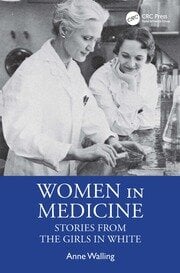
As a medical student in the late 1960s, Anne Walling was required to read a book called “Boys in White.” It was the standard sociology textbok about medical students, and it completely ignored women. Walling didn’t forget.
When it came time to name her own book about the challenges facing women doctors of that era, she couldn’t help but call it “Women in Medicine: Stories from the Girls in White.”
“The whole idea was to try to get an honest picture of what it was like to go into medicine and live as a woman doctor at that time,” said Walling, a retired Wichita physician and educator.
The picture may be a little different than people expect. Published last month, “The Girls in White” is now available in local bookstores and online.
In an interview, Walling said the book grew out of a research project that started with conversations among older female physicians in Wichita. The women had all entered medical school in the 1950s, ’60s and early ’70s, and were rightly viewed as trailblazers by a younger generation of female doctors, who said things to them like, “You were so brave! It must have been so tough!”
The actual consensus of the older physicians was less dramatic. “You know, it was tough, but it was a lot of fun, too,” Walling said. “We all had the feeling our history was being reinterpreted in sort of a negative way. We all had 50-plus years of good careers.”
“They didn’t deny there was a lot of prejudice against women,” she said. “They pointed out that people nowadays don’t realize it was the ’60s and ’70s, and that was just the way the world was. The other thing (younger doctors) don’t realize is that medical school was tough on everyone. The men had a tough time, too.”
Walling’s experience differed slightly from her peers. A native of Scotland, she graduated from the University of St. Andrews School of Medicine in 1971 and moved to the United States with her husband, Dr. Adrian Walling, in 1980, taking a job with the University of Kansas School of Medicine the next year. At the time, she noted that women physicians were more common in Great Britain than here.

Anne Walling has written about a book about what it was like to be a woman doctor before that was common.
“The influx of women into medicine (in the United States) was just getting underway,”
Walling taught and held several other roles at the medical school before taking professor emeritus status in 2017. She’s a prolific writer on medical topics and has been an associate editor of the journal American Family Physicians since 1989.
In 2016, Walling got the ball rolling on an oral history project involving 23 senior female members of the Medical Society of Sedgwick County. It was called “The Only Woman in the Room.”
Then in 2019, she partnered with the University of Kansas Medical Alumni Association to contact women who’d earned their medical degrees before the influx of women into medicine in the mid-1970s. Walling interviewed 37 women doctors who’d practiced 13 different specialties in 16 states and several other countries. The oldest had graduated from KU’s medical school in 1948
“She was a great lady,” Walling said. “She was in a nursing home in North Carolina. She was determined to take part (in the research). She just had a whole life of service to other people.”
Another participant, who was 88, “said she’d ‘promised (her husband) I’d retire when I was 90, but he’s dead.’ They all had a great sense of humor.”
The interviews were intended for a research project, so there was a set formula to the questions and the identities of the women are not revealed, but their personalities still come through at times. The book starts, for instance, with the tale of a 10-year-old Kansas girl watching as a boy who’s been seriously wounded in a hunting accident is brought into the office of her father’s rural medical practice. But her father is away delivering a baby, and her mother, a nurse, can only attempt to stop the bleeding before the boy is driven in a truck over unpaved roads to Wichita. The girl — one of Walling’s interviewees — decides on the spot to become a doctor.
The first opposition some women overcame to becoming a doctor was in the admissions process for college and medical school. After asking about pre-med courses, one recalled, she was told “girls don’t do pre-med. I just smiled sweetly at them and said, ‘What courses are required?’ And I did them.”
“They didn’t fight the system,” Walling said. “They kind of smiled sweetly and navigated the system.”

Second-year medical students Lisa Jenkins, Mary Ann Lauver and Eva Roeder prepare for a pathology class in 1972. Photo courtesy of University of Kansas Medical Center Archives, Kansas City, Kan.
Women applying to medical school “were all asked about getting married and having children,” she added.
Once in medical school, they were a tiny minority. There were two female graduates in 1964 and four in 1968. “There was a lot of sexism that took a lot of different forms,” Walling said. “Everything from being touched and teased to the financial aspect when they tried to get loans to set up practice.”
Once in practice, she said, “One thing that really got them was not being taken seriously as competent professionals — always having to prove yourself, work twice as hard as the men.”
Many of the women had young children early in their careers. One told a story of a babysitter becoming ill during her residency shift. She found someone to cover her shift, raced to the babysitter’s house to retrieve her child, sped to another babysitter’s house to drop the child off, then raced back to the hospital, getting pulled over by a police officer along the way.
“She said, ‘I burst into tears and told him what happened, and he said, ‘You got enough troubles, lady,’ and gave her an escort.”
“They all talked about having to have multiple backup systems when they had little kids.”
But with the exception of one participant, all said it was worth it.
“They all talked about the privilege of practicing medicine for 50 years and the intellectual challenges. They really loved what they did.”
Wichita radiologist Joy Darrah, one of the physicians Walling interviewed, was one of 20 women in the 1971 graduating class of 200. Darrah said Walling’s research “introduces people to the way things were as opposed to the way things are now.”
“I think all the adversities we met, you just kept plowing through to get to where you wanted to go.”
Darrah, Walling and others like them helped usher in a new era of medicine. From a tiny percent in the 1960s, women now comprise a majority of the students enrolled at U.S. medical schools.
“They just did their jobs and made it credible for women doctors to be recognized as good doctors,” Walling said. “Without them, it wouldn’t have happened.”
Book talk at Watermark
Anne Walling will discuss “Women in Medicine: Stories from the Girls in White” at Watermark Books & Cafe, 4701 E. Douglas Ave., at 6 p.m. on Thursday, Aug. 21. Signed copies of her book are available at the store.