
HAYS — For as long as teenage boys’ bedrooms have had windows, young gentlemen have been sneaking out at night to meet up with a girl. Hays isn’t the only Kansas town where that’s happened. But it may be the only town in America where multiple generations have all attempted to hook up with the very same young lady.
Sons, fathers and grandfathers of Hays have all tried to catch a glimpse of the same elusive young woman for more than a century. Some say they’ve seen her walking the hills at night, wearing a blue dress and carrying a lantern. They call her The Blue Light Lady. But her real name is Elizabeth Polly, and she’s a ghost.
Back in 1867, Elizabeth was a hospital matron, caring for the soldiers at Fort Hays during the cholera epidemic. She was completely devoted to her patients during the day. But at night, she’d go for long walks outside the fort to rest her mind and recharge for another stressful day. Elizabeth was able to nurse several desperately ill soldiers back to health. But then she contracted cholera herself, and died when she was just 24. According to the legend, she still walks the hills outside of Hays with her blue lantern, searching for soldiers to comfort.
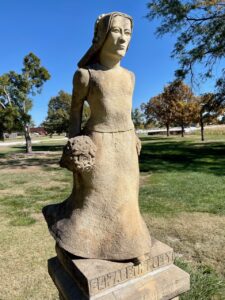
Elizabeth Polly might have been completely forgotten by now, if not for the limestone sculpture of her that stands in, appropriately, Elizabeth Polly Park. It’s one of the smaller parks in Hays, out behind the Dairy Queen. And Elizabeth Polly is one of the lesser-known historical figures that Hays sculptor Pete Felten has immortalized in limestone.
Felten’s sculpture of former Hays city marshal and sheriff Wild Bill Hickok stands downtown in Union Pacific Park. His bust of Buffalo Bill Cody, who served as an army scout and buffalo hunter here, sits in front of the library on Main Street. And one of Pete’s favorites, The Lawman, keeps watch in front of City Hall, coat tucked behind his Colt revolver for quick access. “It’s across the street from my house, so I can see it from my kitchen window,” Pete says.
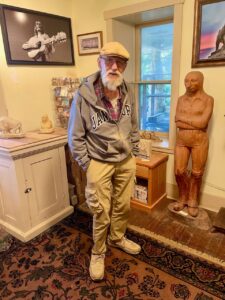
Pete Felten started teaching himself how to carve in 1957 when he was 24. He turned out to be an excellent teacher and a dedicated student. His sculptures of Amelia Earhart, Dwight Eisenhower, Arthur Capper and William Allen White stand in the rotunda of the Kansas Statehouse. Other Felten sculptures can be seen in Atwood, Oberlin, Victoria and elsewhere. But Hays is Pete’s hometown, and it’s also home to the majority of his distinctive stone art.
His largest creation is the massive Monarch of the Plains that stands outside Hays, overlooking Highway 183. It started as a 24-ton slab of limestone. Pete began chiseling away at it in 1965. Two years later, an 18-ton Kansas bison emerged from the enormous rock. Pete completed the project in 1967, in time for the Hays Centennial. My wife and I were students at Fort Hays State at the time, and we often saw Pete hurtling through town in his battered old jeep.
He’s not mashing the accelerator down quite as hard now. But until just recently, Pete was still carving every day. He told us he first started thinking about working with limestone when he was a kid, spending summer days at the old swimming pool in Hays. “Some kids had carved their initials into the old limestone building,” he said. “I saw that it was easy for them to do because limestone is pretty soft. So I decided to try making some sculptures out of it.”
He had no trouble finding enough stone to practice on. Farmers had used limestone posts to build fences for a century in that part of Kansas. Many of the old fences had fallen into disrepair, so farmers were happy to let Pete wrestle the heavy posts out of the ground and haul them off. He practiced until he became proficient. Pete Felten had found his profession.
There are more than two dozen Felten sculptures in his hometown, but they aren’t the only reason why Hays makes a great day trip destination. The Sternberg Museum of Natural History houses some three million fascinating exhibits, including their popular fish-within-a-fish fossil and some animated dinosaurs. And at the old Fort Hays State Historic Site, you can step into the officers’ quarters where General Custer and his wife Elizabeth lived while he was stationed at the fort here. After you’ve immersed yourself in enough history, Hays also has a couple of award-winning microbreweries where you can cut the trail dust with a tall cold one.
But before leaving town, be sure to search out as many of the Pete Felten sculptures as you can. You’ll marvel at the way he’s skillfully recorded history with his chisel. And like me, you may wonder if he ever made a mistake.
“Did you ever work on a big sculpture for a year or two, have it almost finished, then give the chisel one last little tap and have an entire arm fall off?” I asked him.
Pete looked at me for a minute before answering. “No,” he said. “I try to avoid that.”
Joe Norris is a retired Wichita marketing executive. He can be reached at joe.norris47@gmail.com.