
Allen Goodwin remembers the thrill of piloting a Lear Jet Model 23 made in Wichita during the 1960s.
“Those of us who flew 23s for a living — it was a beautiful piece of engineering,” said Goodwin, a former test pilot for Learjet. “You either wanted to fly this one or a G2 (Gulfstream II). They went faster than anything else and went higher than anything else.”
To be precise, 80 percent of the speed of sound and 41,000 feet. Referencing the handling and sleek design of the aircraft, Goodwin added, “This one, you wore it.”
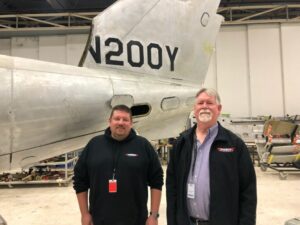
Memories like that are driving Goodwin and other volunteers to restore a 62-year-old Lear Jet Model 23 — the first Learjet to be delivered to a buyer — back to flying condition.
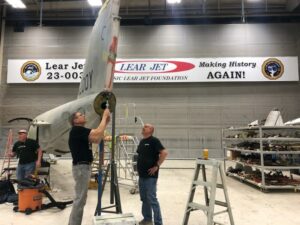
A couple of days each week, volunteers work on the restoration in a former paint shop on the edge of Eisenhower National Airport, across the street from the plant where it originally was put together.
It won’t be easy, fast or cheap.
The twin-engine, eight-seater has barely been flown in 30 years, spending most of that time deteriorating in an airport in Bartow, Florida. Restoration costs are estimated at $3 to $5 million.
The volunteers say the plane is significant enough to warrant the effort: The Lear Jet Model 23 changed business and culture around the world by getting people of certain means where they wanted to go faster than had ever been possible.
Not to mention making good paychecks possible for thousands of Wichitans.
When restored, they hope the jet will be as much of the city’s aviation legacy as the Kansas Aviation Museum and “Doc,” the B-29 Superfortress built by Boeing during World War II and put back into flying shape decades later by another local group of volunteers.
“There’s no shortage of topics this airplane can segue into,” said Bill Kinkaid, president of the Classic Lear Jet Foundation.
Learjet’s beginnings
Learjet was started by Bill Lear in Switzerland in the late 1950s and moved to Wichita in 1962 (the company name started as two words and later became one). For Lear, the draw was Wichita’s aviation workforce, forged in the early days of flight and massively expanded during World War II.
Lear based the Model 23 on a Swiss military aircraft. The prototype crashed and burned shortly after taking off on a test flight from Wichita in June 1964. Its pilots escaped unharmed, and the insurance money actually helped Lear move forward. The second Model 23 became the program’s experimental test airplane and is now part of the Smithsonian Institute’s collection.
The one being restored — bearing serial number 23-003 — was delivered to the Chemical and Industrial Corp. of Ohio in October 1964. It proved so successful that the buyer acquired more and went into the charter jet business.
It also became a favorite of Hollywood celebrities. A video on the foundation website shows Frank Sinatra, Johnny Carson and others with Lear Jets.
Lear, a serial inventor (he’s also credited with creating the 8-track player) of mercurial nature, sold his stake in the company in 1967. But Learjets continued to be produced until Bombardier Aerospace, which acquired the company in 1990, announced they would be discontinued in 2021. By then, more than 3,000 had been produced, making Learjet a synonym for private jets at one point. After its initial sale, the third Lear Jet ever produced changed hands several times, flying a bit around Alaska and elsewhere before a Florida beer distributor bought it. Its last owner was a Florida family involved in air shows.
Other than a two-hour flight to Bartow from another Florida airport, it hadn’t been flown in decades. Members of the restoration effort say none of the 99 Model 23’s produced are currently in use, although some 24s and 25s are still flying.
In 2022, the plane’s owner contacted Dick Kovich, considered the unofficial historian of Learjet, to see if there was interest in acquiring it. According to Kinkaid, there wasn’t, at least not at the original asking price of $250,000.
‘Not physically possible’
Another obstacle was the desire of the plane’s owners to see it restored to flying condition, not just displayed somewhere. Kinkaid and others were skeptical that could be done.
Bart Gray, a Florida businessman and pilot involved in the restoration, said his initial thought was: “That’s not physically possible.”
Gray, who runs an international air ambulance service, had earlier approached the plane’s owners about acquiring it to put on a pole outside his business.
Many of the plane’s parts had deteriorated in the harsh Florida environment; others had been damaged in a hurricane.
Replacement parts would have to be custom made because they aren’t being manufactured anymore. The degree of difficulty was upped because the object isn’t simply to get the plane flying again. Instead, it is to “restore it to the way it was delivered in 1964,” in Kinkaid’s words.
A turning point came when Kinkaid and others met with the group that spearheaded the restoration of Doc.
“They told us we were setting our sights too low,” Kinkaid said.
Doc had been found rotting in the Mojave Desert in 1987. With help from a group called Doc’s Friends, volunteers restored it to air worthiness in 2016. Today, it’s flown at air shows and other events and, when not in use, is housed in the 42,000-square-foot B-29 Doc Hangar, Education & Visitors Center at the airport.
After Doc’s Friends explained the business plan that made that happen, Kinkaid and others flew to Florida to check out the Model 23.
“It was essentially all there in one piece,” Kinkaid said. The electrical systems “powered up without any smoke or anything like that.”
The plane’s owners agreed to take $90,000 for it. More than half the price was donated by Clay Lacy, a legendary figure in Wichita aviation, and Lynn M. Krogh, founder of Colorado-based International Jet Aviation Services.
‘Good time to get involved’
The plane was partially disassembled and trucked to Wichita in February of 2023, originally parked in a hangar — now part of Bombardier — near where it was built. Restoration began the next year. To date, volunteers have put in about 2,000 hours working on the aircraft.
“There are lots of hard parts,” Kinkaid said when asked about the work. “In the top three are corrosion repairs, the rewiring of the plane and CRO — component repair and overhaul.”
The aircraft contained 2.3 miles of wiring which will be re-manufactured.
Dan DeMott, who worked at Learjet for 32 years, said he’s been happy to donate his time and experience to the project.
“I know most of the guys who are involved. I’m kind of a history buff, and I retired a year ago, so it was a good time to get involved.”
On a recent day, the volunteers were readying the aircraft for x-ray photography that would be used to detect any structural defects not apparent to the naked eye.
Gray, whose company owns several Lear Jets, has completed an around-the-world flight in one of them — and another flight circumnavigating both poles —to raise money and awareness for the project.
Several aviation-related companies with links to Learjet have made in-kind donations of material, equipment and labor. The engines, for example, are being overhauled by a Michigan company.
Kinkaid hopes it can be done in five years. The foundation has been set up as a 501(c)(3) nonprofit to raise funds.
“The project will go as fast as donations occur,” Kinkaid said. “At the end of the day, we want to operate it like Doc.”
To make a donation or get more information, visit https://ClassicLear.org.