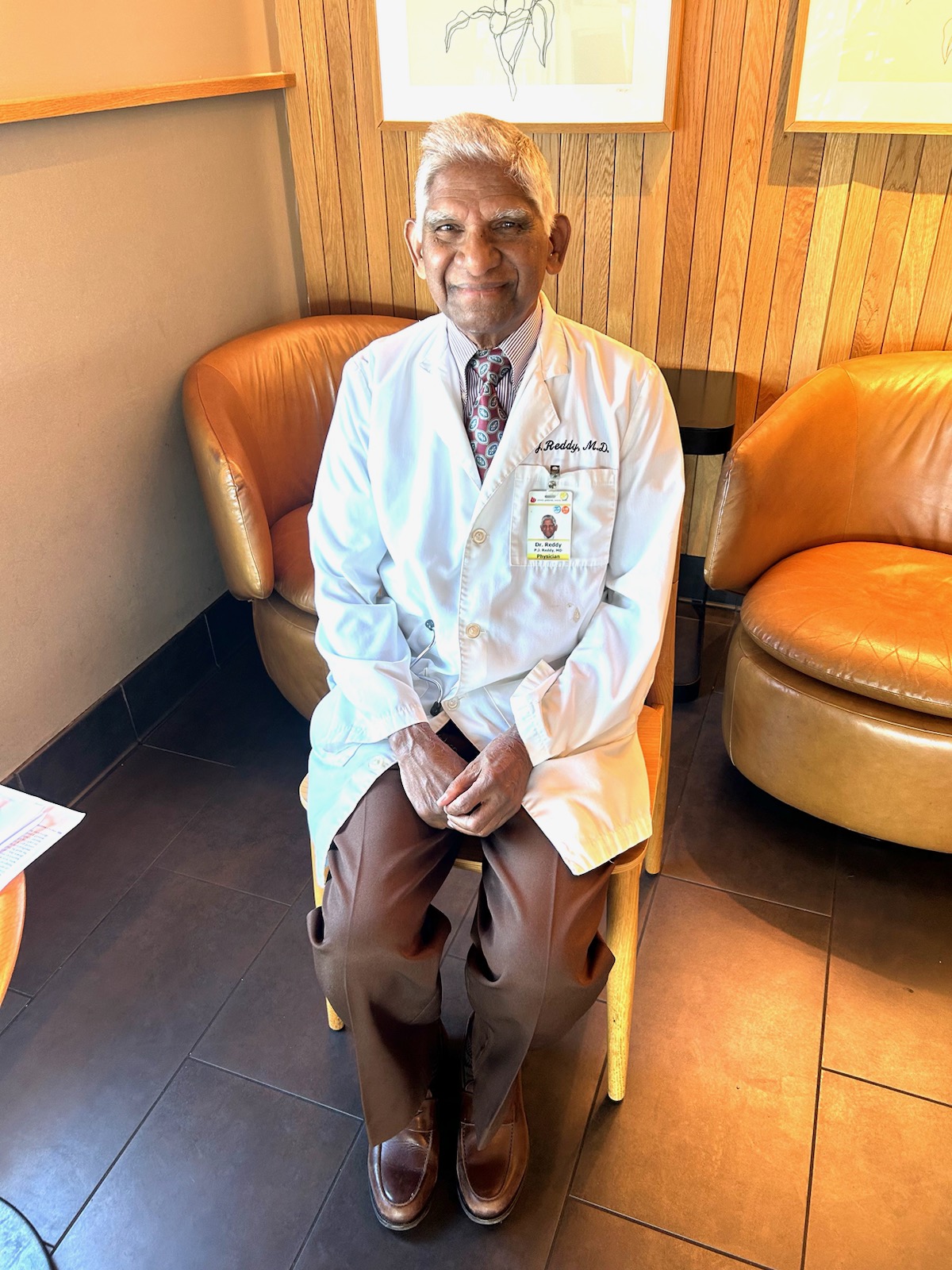
How does a physician and surgeon from India end up practicing in a small town like Hill City, Kansas?
One patient at a time.
That’s the story for Dr. P.J. Reddy, who practiced in that Kansas town for 41 years before retiring to Wichita in 2014. Born in Andhra Pradesh, India, in 1942, Reddy was the son of a doctor of Ayurvedic medicine (a traditional, holistic healing system from India that uses herbs, diet and lifestyle changes to balance the mind and body). He was encouraged to study medicine by his father and uncle, coming to America in 1967 to pursue greater opportunities.
“After finishing my general surgery residency in New York, I did one year of plastic surgery training in Syracuse,” Reddy said. “In those days, most young surgeons wanted to go into solo practice or join a group practice. In my case, I was uncertain whether patients would come to see me or not since I am from a foreign country.”
Reddy found an ad in a medical journal and learned that the Graham County Hospital in Hill City was looking for a physician. He called the hospital and spoke to the CEO, who asked him to come in for an interview. He agreed and flew to Hays, which has the closest airport to Hill City. To his surprise, the CEO of the hospital came to the airport to greet him and drive him to Hill City, which is about an hour northwest of Hays (and named for its founder, not its elevation).
“At the time, I did not realize Hill City was a small town, with a population of about 3,000 and a county population of about 4,000,” Reddy said. “The CEO took me around Hill City and then to the hospital, where he introduced me to the hospital board members.”
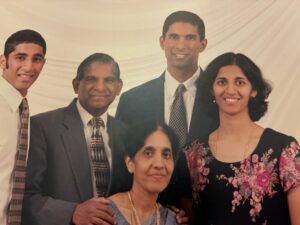
Dr. P.J. Reddy and his wife, Nalini, now live in Wichita. They are shown here with their sons, Sridhar and Gautham, and daughter, Madhavi.
The board offered Reddy a job on the spot, asking him to sign a two-year-contract, which eventually extended into another six years. It was 1973, and Reddy moved with his wife, Nalini, and 2-year-old son from New York City. The day after the move, he started seeing patients.
“A few days later, the CEO of the hospital took me to his house. His wife told me, ‘I heard that people like you,’” Reddy said. “I was glad to hear that, because my motivation was to take care of patients to the best of my ability and knowledge.”
It did not take long for Reddy to get established. He started performing major operations in the fall of 1973. Reddy has kept count of his surgeries, which ranged from appendectomies to cholecystectomies (gall bladder removal) to tonsillectomies. In all, he has performed more than 3,500 operations and procedures.
When faced with an operation he had not done before, Reddy would often educate himself the day before the surgery.
“I had several books on operating procedures. Many times, I would read up on a procedure the day before an operation like a hysterectomy or C-section and do the case the next morning. If you want to practice surgery in a rural area, you must be prepared to do a wide range of operations, and it is better to be familiar with as many as possible.”
Reddy says he rarely encountered complications.
“I recall two cases with common bile duct injury while doing lap chole. I sent those patients to a bigger hospital, where they received appropriate surgical care.”
Can I get a refill?
After his contract with the hospital was up, Reddy went into private practice while continuing to perform surgeries. He grew his patient base and says he truly learned what it meant to be a small-town doctor. He laughs now at some of the stories.
One day, he was driving out of his garage when a neighbor, who was also his patient, waved at him to stop.
“I rolled down my car window, and he said he had run out of medication and asked if he could get a refill. I told him to call the clinic and ask my nurse,” Reddy said. “Only in a small town would a patient stop you in the driveway for a prescription refill.”
In another case, Reddy performed a dilation and curettage on a patient one morning around 8 a.m. A few hours later, when her condition was stable, he dismissed her. As usual, he returned to the hospital that evening to check on other patients.
“When I went back that evening, the patient who had had the D&C was still in her hospital room,” he remembers. “I was surprised and asked her why she hadn’t gone home yet. She said she was waiting for her husband to pick her up because he was at a board meeting. Since she was my neighbor, I offered to take her home. She thanked me, and again I thought, only in a small town would you drop a patient off at her home.”
Reddy also performed obstetrics and gynecology in his practice, because Hill City did not have a specialist. One day, a woman came to his office with labor pains. She was full-term and having contractions. Reddy told her to go directly to the hospital where he would meet her and deliver the baby.
“The woman said, ‘Doc, my friend who dropped me off here went shopping. I have to wait for her to come and pick me up and take me to the hospital,” he recalls. “I told her, ‘There is no time to wait, you better go to the hospital now.’ She had no transportation, so I took the patient in my car to the hospital where I delivered the baby. I don’t think you will see many physicians in non-rural areas taking the patient to the hospital and delivering the baby.”
Not a moment to spare
One day, he was in the delivery room preparing to deliver a baby. A nurse came in saying that another woman was in labor in the next room.
“I delivered one baby in the delivery room, handed the baby to the nurse, and left the placenta inside,” said Reddy. “Then I went to the next room, changed my gloves, and delivered the baby. I handed that baby to the nurse and left the placenta inside. Then I went back to the first room, changed my gloves and delivered the placenta. Then I went back to the second room, changed my gloves and delivered the placenta. These things can happen when you are the only physician in town delivering babies.”
The next chapter
While Reddy never envisioned spending four decades in a small town, he grew to love the community and his patients.
“The thing was, I was busy. Patients would come and see me, they kept me busy, and I just decided to stay there instead of moving to a bigger city,” he said.
When Dr. Reddy was ready to retire, he decided to move to Wichita where he and Nalini could be closer to two of the couple’s three children. Medicine runs in the family. Their eldest son, Gautham Reddy, is a Wichita neurologist; Gautham’s wife is a pediatrician. Their daughter, Madhavi, also lives in Wichita and is married to an oncologist, Dr. Pavan Reddy. Their youngest son, Sridhar, is an oncologist in New York.
After coming to Wichita, P.J. Reddy worked part time in the wound care clinic at Wesley Medical Center; he later volunteered at the Mayflower Clinic, which served people without health insurance. When the clinic closed two years ago, Reddy fully retired.
He exercises daily at the East Wichita YMCA and spends much of his time reading and writing. He’s a lifelong learner and wants to share his medical wisdom with colleagues as well as the general population. He’s published articles in medical journals as well as mainstream newspapers and print publications.
“My motivation is always to make the patients better,” Reddy said. “But I do it for me as well. My motto is, ‘Help others to help yourself.’”
Reach Sherry Howerton at sgaylegraham@hotmail.com.