It took Carol Cole a while to appreciate all that makes St. Paul A.M.E. Church special.
Sure, the church seemed grand and even a little intimidating to her as a child, its sanctuary filled with beautiful music and stirring sermons. But maybe she didn’t pay enough attention to who was filling the pews.
“As I look back on growing up in the church, we had no idea we were among giants — doctors and lawyers and teachers,” Cole said. “They were just members to us. As you get older, you recognize their significance.”
The church, Wichita’s oldest African American congregation, celebrated its 150th anniversary last month with more music, worship and recognition of members who have made it a force in the black community and beyond.
“It’s just incredible that the church has existed this long,” said Carol’s sister, Carla Eckels, director of organizational culture at KMUW. “I’m just really proud to be a member there.”
St. Paul got its start in 1875, five years after Wichita’s founding. At the time, according to a church history, the town’s relatively few black residents held weekly worship meetings in each other’s homes, regardless of denomination. The decision to organize an African Methodist Episcopal church was made in June 1875, and the church’s first official meeting was held in the home of Mr. and Mrs. Joshua Robinson on Aug. 25 of that year. The A.M.E. denomination had been founded by Richard Allen, a former slave, in Philadelphia in 1816 and remains one of the largest Methodist denominations in the world.
The Wichita congregation grew fast.
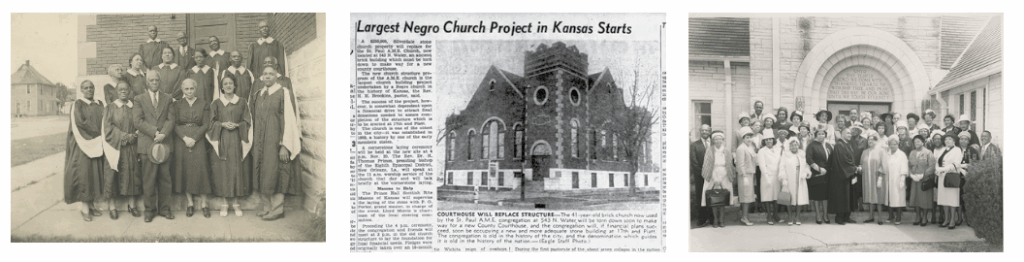
Photos courtesy of the Wichita-Sedgwick County Historical Museum
Above left, members of St. Paul A.M.E. are shown outside their church at 541 N. Water circa 1940 and their current church, right, at 17th and Piatt during its 1956 dedication. Center, a newspaper article about the church moving to make way for the Sedgwick County courthouse.
Early days
Its first preacher, Rev. Dudley Carter, visited Wichita once a month, as part of a circuit that included Newton and Emporia. In 1876, the congregation moved its services from the home of Mrs. Susan Johnson to a rented building at the corner of 2nd and Main streets and adopted the name St. Paul A.M.E. Church.
The next year, the A.M.E. conference assigned the church its first resident pastor. Two years later, the congregation bought a house on North Water Street, then the heart of the city’s African American business district, to serve as St. Paul.
The congregation’s first brick church was erected nearby before the decade was out. In 1918, a new church was completed on North Water that served until the 1950s. By then, church membership was declining and Sedgwick County wanted its site for the present county courthouse and jail.
That’s when Rev. H.H. Brookins arrived from Lawrence with a vision for the church “as a change agent in society, challenging injustice and equipping its members to take on racism in Wichita,” according to the church history. St. Paul bought land at 17th and Piatt and dedicated its present church with fanfare in 1956. An engineer and master plumber who were congregation members supervised construction.
Civic activism
According to another history of the church, by Gretchen Eick, author of the 2001 book “Dissent in Wichita,” Brookins was the “role model and inspiration” for some of the NAACP Youth Council members who staged sit-ins that eventually desegregated lunch counters in Wichita. Older female congregation members helped lead another effort to desegregate local restaurants.
Both Brookins and Rev. Vinson Anderson, who served St. Paul from 1959-64, were later elected bishops. Anderson and his wife, Vivienne, an accomplished speaker in her own right, led the church during its greatest period of expansion, according to Eick.
Rev. A.A. Morgan, who succeeded Anderson, led the congregation in partnering with the federal government to build three public housing projects at a cost of $6.2 million, reportedly the largest such project undertaken by an A.M.E. church. The effort added hundreds of housing units to northeast Wichita and the Plainview area.
Modern challenges
More recent pastors have focused on a variety of needs: day care, HIV/AIDS in the black community, health care for the uninsured, youth ministries and more mundane but necessary pursuits like debt reduction and building maintenance.
St. Paul’s current pastor, Rev. Pamela M. Hughes, arrived in 2018. “Pastor Pam,” as she’s known throughout the city, is the church’s longest-serving pastor and the first woman in that role. The A.M.E. denomination assigns pastors to churches on an annual basis. St. Paul is Hughes’ eighth church, including assignments in her home state of California, Las Vegas, Leavenworth and Topeka.
Hughes has already seen St. Paul through two major challenges. When the COVID pandemic hit and caused in-person services to be suspended, she and a skeleton crew of musicians and singers broadcast services live via Facebook, while the church set up a drive-through service for communion wafers, bulletins, books and other items parishioners might need. “For some seniors, that was their only outing” during the worst of the pandemic, Hughes said.
“I don’t know if we could have made it through COVID without this wonderful woman of God,” Cole said of Hughes.
Then in 2024, the church’s boiler system began breaking down. After two trustees, Harold Miller and Tony Tatum, spent months pumping water out of the basement, the congregation was able to install air conditioning in the sanctuary, fellowship hall and other areas of the church.
Hughes has maintained the church’s community involvement. She serves as first vice president of Justice Together, an organization focused on mental health, affordable housing and homelessness. She’s also interim president of the Greater Wichita Ministerial League, an interdenominational group of pastors, clergy and friends of the league.
‘We are Methodists’
Hughes attributes St. Paul’s long history to the fact that it is “a place that anyone can go to worship. We’re open to all ethnicities. There were educators, organizers and others involved in all kinds of causes.”
“We are Methodists,” she added. “There is a method to what we do.”
The Jubilee celebration included a concert featuring nearly a dozen local gospel artists, a brunch filled with tributes to noted members and a Sunday worship service where A.M.E. Bishop Francine Brookins was the guest preacher. She is the daughter of H.H. Brookins.
“We have so many members we haven’t seen in a number of years,” said Carol Cole, who co-chaired the celebration. “It’s as if people are coming home, and we’re seeing new members.”
Cole, the fourth generation of her family to attend St. Paul, has seen it subtly change over the years without losing its focus on inner spirituality and the greater good. “I can recall, as a child, it was kind of staunch,” she said. “Now it seems a little more — I don’t want to say open, because it’s always been open — but a little more free-flowing than when I was young. Now there is more praising freely.”