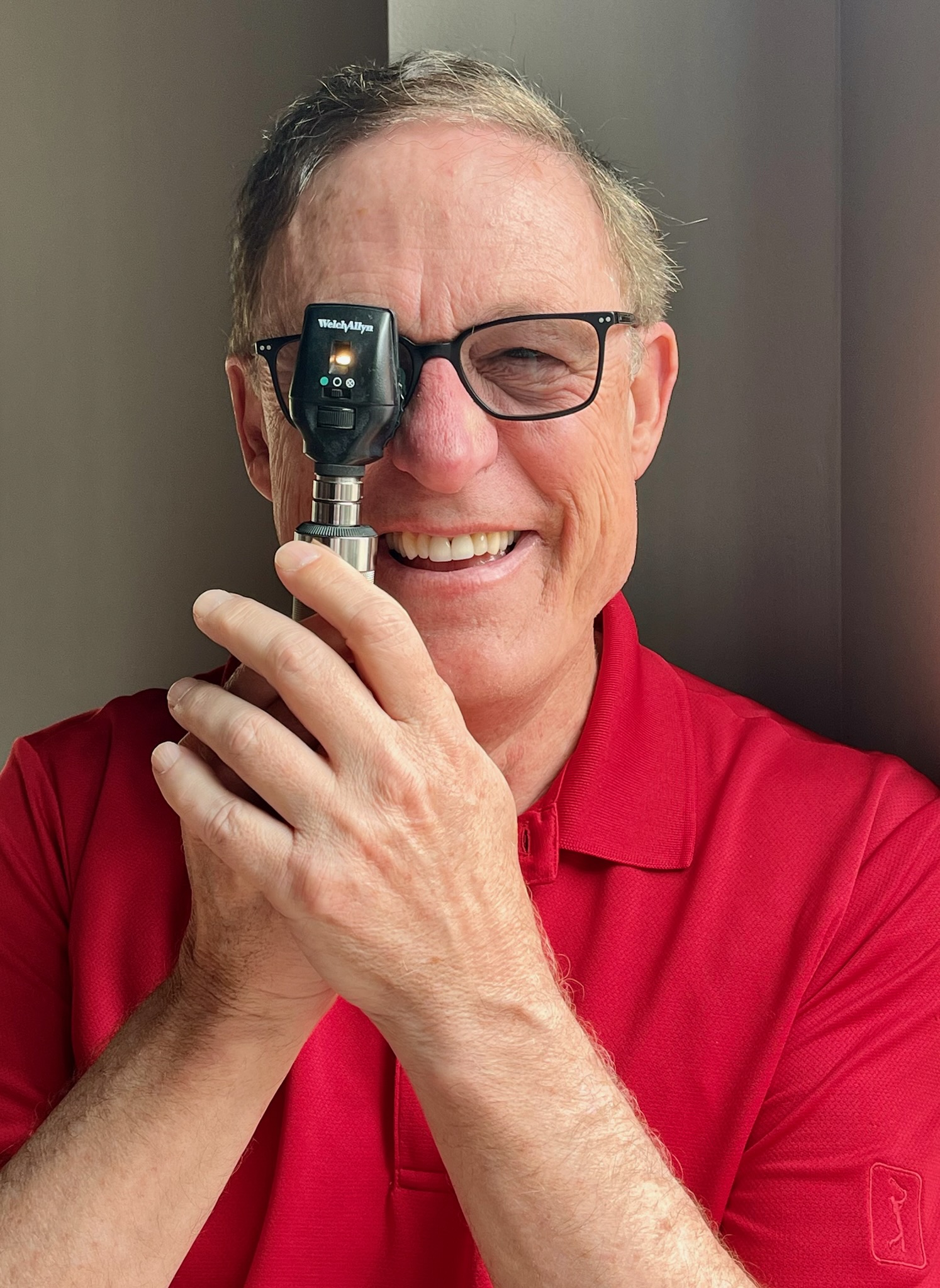
Usually when a Kansan heads to the Caribbean, it’s for beaches and a deck chair, fancy drinks and lots of sun.
Dr. Patrick Pirotte derived an entirely different kind of enjoyment from his trip earlier this year — the satisfaction of bringing better vision to children in the Dominican Republic. Pirotte, a pediatric optometrist in Wichita, was one of six eye doctors from the United States who visited Santiago, the country’s second-largest city, on a weeklong medical mission.
Pirotte said the experience “is kind of like ‘MASH,’ the TV series, in that you establish camaraderie quickly in doing the hard work and trying to see as many patients as possible.”
The mission was a partnership of Creighton University and the Jesuit-affiliated Centro de Educacion para la Salud Integral (known in English as Mision ILAC), whose campus provides health care to low-income rural communities in the area.
“Over the course of five days, we did 1,070 eye exams,” Pirotte said. The team treated many glaucoma patients and provided follow-up care to patients who’d had surgery performed by a previous mission team. Peace Corps volunteers provide translation between the doctors, local staff and patients.
Due to Pirotte’s expertise in pediatric cases, younger patients were funneled his direction. Pirotte and another doctor also visited an orphanage one day and treated 88 kids, including a 2-year-old boy so severely near-sighted that he would not be able to function in school without prescription glasses.
Perhaps the most memorable experience of the trip was the relief and gratitude expressed by the mother of a boy whose vision Pirotte assessed. The child has cerebral palsy, and his mother thought he was also completely blind. Pirotte was able to show her that her son has some vision. That means she has another way to communicate with him and offers hope for his ability to interact with other people in the future. “Being completely blind is actually very rare,” Pirotte said.
A Wichita native, Pirotte grew up in Indian Hills. He attended St. Patrick’s and Bishop Carroll, then the University of Kansas and Southern California College of Optometry in Fullerton, Calif. He trained in classical piano and, for fun, often plays Gershwin tunes, jazz and other music from the 1920s and ’30s for small groups. He’s also a self-proclaimed gym rat, lifting weights and taking tai chi and water classes at the downtown YMCA.
Pirotte founded Child and Family Eyecare in west Wichita in 1985 and has taken part in previous medical missions to Mexico. As he nears retirement, he said he has found his career rewarding. He likes to say that vision “is the queen of the senses, and when the queen is unhappy, no one in the castle can sleep.” According to Pirotte, over half of a person’s brain is directly or indirectly devoted to processing visual information, and visual perception is tightly intertwined with other brain functions such as memory, spatial awareness and motor control, all of which contribute to more engagement with life, careers and relationships.
Pirotte said it’s gratifying to see a baby’s face change when glasses suddenly allow the child to see clearly for the first time — no doubt why videos of it happening are popular on the internet. “The actual response you get,” he said, “is that the child will go completely silent and just look all around because of the overwhelming visual information they are experiencing for the first time.”
But, for Pirotte, even that is overshadowed by the feeling he gets when a young patient comes back and reports acing a school test because he or she is finally able to see clearly.
Small wonder he’s heading back to the Dominican Republic in January.
For more information about Mision ILAC programs, visit ilac.org.do
Contact Melanie Jenney at mjenney@gmail.com.