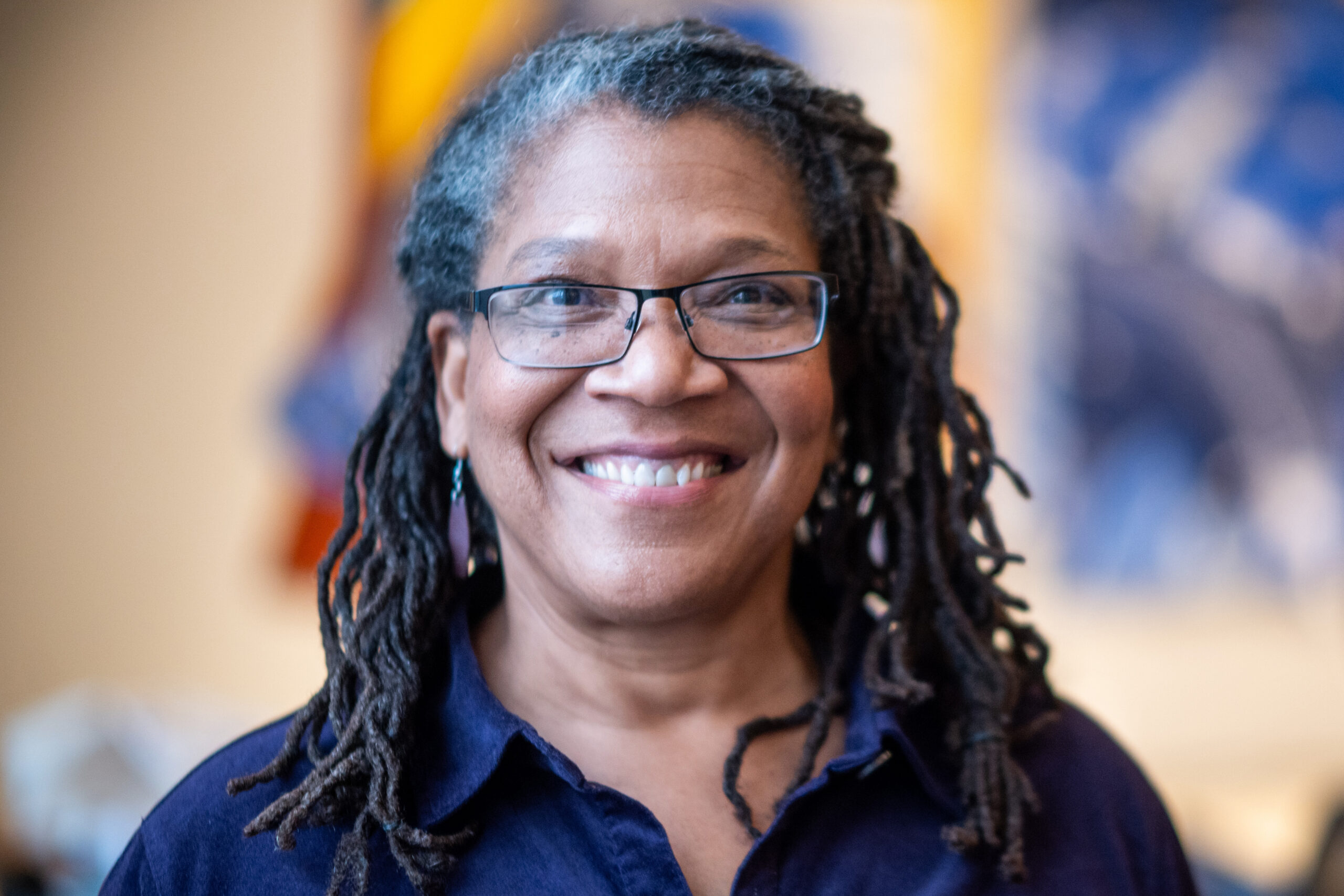
Donna Rae Pearson feels like she’s just scratched the surface of a topic that doesn’t get much attention: the history of black leisure in Wichita.
“Yes, we enjoy recreation and leisure activities,” said Pearson, a Wichita native and museum curator at the Kansas Historical Society in Topeka. “That’s not what you ordinarily hear about when you talk about black history — spaces and places and how it happened in Wichita.”
Pearson spoke about the topic during the Wichita Art Museum’s Senior Wednesday program April 7. WAM invited her in conjunction with an exhibit called “Safer Waters: Picturing Black Recreation at Midcentury” by artist Stephen Towns, which runs through June 14.
Segregation wasn’t as pronounced in Wichita as in certain parts of the United States, but it existed both formally and informally. As a result, the city’s African-American residents often created their own places where they could enjoy themselves.
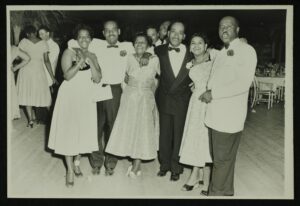
The caption for this undated photo taken by Leon Hughes reads: “Mrs. & Mr. Alvin Horn, Mr. & Mrs. Willard Lee, Mr. & Mrs. Vernon Gill after celebrating at the Mambo Club.
The program started with a slide show of photographs taken by Wichitans Leon and Rosie Hughes from the late 1904s through the 1970s. Pearson called them “really beautiful images of black Wichita that helped spur that conversation. It’s not the first time I’ve looked at that collection.” (The photos can be viewed online at the University of Kansas libraries digital collection, digital.lib.ku.edu/ku-hughes/root).
Pearson said churches and Masonic organizations helped shape much African American life outside work and school. For instance, St. Paul AME Church sponsored the city’s black YMCA, which started in 1908 as the Water Street branch and later was named for black leader Walter Hutcherson. It moved to the McAdams Park area before being incorporated into the North YMCA in the 1960s.
McAdams Park and the nearby Cleveland Street commercial hub were centers of community activity at mid century, Pearson said. McAdams featured a six-hole golf course used by black players before they were allowed onto other city course — it was torn down despite opposition in the 1970s — while Cleveland was home to businesses such as the Dunbar Theatre and Turner’s Corner Drug Store.
Turner’s, which also sold food, fit the concept of a “third place” — a location outside of work and home where people felt comfortable, Pearson said.
“You could go get a burger, you could go relax.”
Pearson, who earned a master’s degree from Wichita State University, was also scheduled to give a second Senior Wednesday talk at The Kansas African American Museum on April 29, focusing on women who played significant roles in the landmark Brown vs. Board of Education racial segregation case.
She plans to revisit the subject of black leisure at some point.
“It’s not something that’s been deeply researched or considered as a worthy topic, so that in itself was interesting to look at the history in that way.”