
When I was in the third grade, Dwight D. Eisenhower was in the White House. I know that because he sent me an award for spelling at the end of that school year. The official certificate featured a nice color photo of the president himself. Ike had signed it, too.
The photo and autograph were both mass produced, of course. But my 9-year-old brain saw it differently. At the time, it was pretty obvious to me that the President of the United States had personally singled me out for recognition. I imagined the scene in the White House as Ike yelled upstairs to his wife: “Mamie! Where’s that special pen with the white ink? I gotta sign a headshot for that Norris kid! You know, the phenomenal speller in Kansas I told you about? Yeah, he nailed ‘gymnasium’ on the first try, and he’s only in the third grade!”
Given the close personal connection I felt with Eisenhower on that day in 1956, it’s amazing that I waited 70 years to visit the Eisenhower Presidential Library and Museum in Abilene, Kan. But our country celebrates 250 years in July, so this seemed like the perfect time to pay tribute to an authentic American hero. And Dwight D. Eisenhower was certainly that.
More than 16 million Americans fought in World War II. Eisenhower, as supreme commander of the Allied Expeditionary Force from 1943 to 1945, planned and oversaw the massive D-Day invasion, then went on to liberate France from Nazi occupation and to direct all the military actions that lead to Germany’s unconditional surrender on May 7, 1945.

A congratulatory letter the author received from the White House while Eisenhower was president. Admission to the museum is free on July 4.
Born David Dwight Eisenhower in Denton, Texas, he and his family moved to Abilene in 1892, when he was about 18 months old. His parents later switched the order of his first and middle names to avoid confusion with a brother, but he was always known as Ike by his family. And he was known by everyone in Abilene as an honest, hard-working kid. Returning to his hometown after the war, Ike said, “The proudest thing I can claim is that I am from Abilene.”
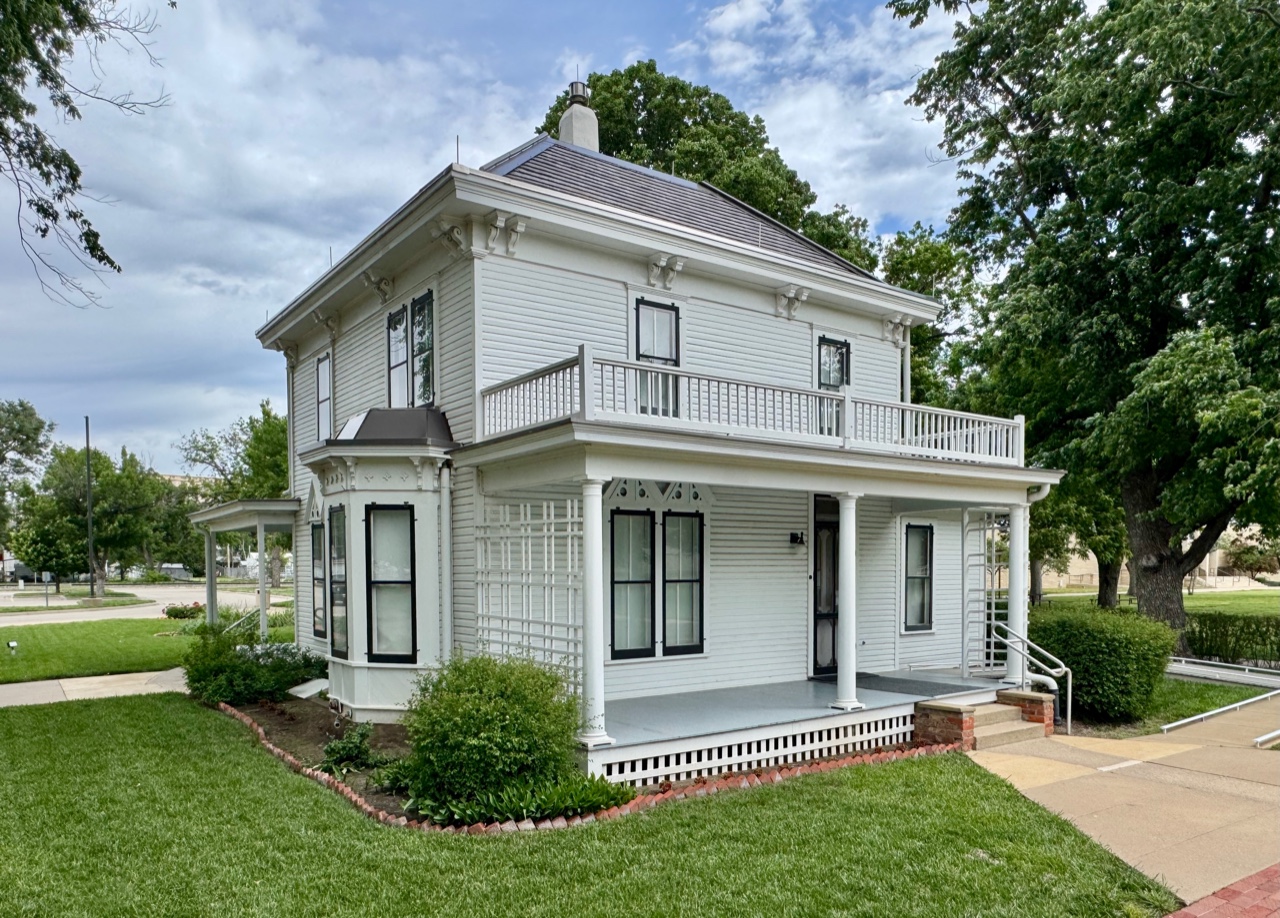
Politicians often pander to hometown crowds with statements like that, but Eisenhower seems to have meant it. Unlike most other presidential libraries, Ike’s is right here in his hometown. It’s the only presidential library located in a small Midwestern town instead of a major metropolitan area. Besides the library and museum, the 22-acre campus also includes Ike’s boyhood home, still sitting exactly where it’s been since 1898. The visitors center was built just a few yards away from the home, on the spot where Ike’s childhood school once stood. And Eisenhower’s remains are buried here in the Place of Meditation along with those of his wife and their first son. The entire campus is simple, dignified and unpretentious — like the man himself.
“I’m just folks,” Eisenhower said. “I come from the people, the ordinary people.”
In the first section of the museum, Ike’s ordinary childhood is engagingly told. To earn money, he grew produce, delivered ice, harvested wheat and worked nights at the Belle Springs Creamery. He also made tamales, using the recipe his mom had picked up in Texas, and sold them door-to-door. Ike was an average student, but he excelled at sports and loved military history. His school desk is here on display, but with no initials carved into the wood. Young Eisenhower knew how to use a pocketknife, but he also knew how to exercise restraint.
In 1911, Ike won an appointment to West Point, where he played football. Photos show Cadet Eisenhower vigorously punting, with his kicking foot stretched far above his head. His bulky letterman’s sweater is here along with other West Point memorabilia.
Eisenhower reported for duty at Fort Sam Houston in San Antonio in 1915. That’s where he met Mamie Doud, a debutante from Denver, less than a month later.
“He was the handsomest man,” Mamie recalled. “A far cry from the society boy lounge lizards with patent-leather hair.”
Four months after their first meeting, Ike proposed to Mamie on Valentine’s Day 1916. They became husband and wife on July 1, 1916. A piece of their 110-year-old wedding cake is here on display, in a little shield-shaped box.
Eisenhowser asked to be sent to Europe during World War I. But top brass denied the request, assigning Lieutenant Eisenhower to command a unit here in the U.S. that trained tank crews. So Ike did not see any combat during World War I.
After the war, he served in various staff positions in the U.S. and the Philippines, reaching the rank of Brigadier General shortly before December 7, 1941. An original paper teletype strip announcing the catastrophic attack on Pearl Harbor is here in the museu. After that, the future of General Eisenhower and the country he loved both changed dramatically.
Throughout the museum, quirky personal items share space with genuinely historic artifacts. The famous D-Day planning table is here, along with Eisenhower’s WWII uniform collection. But so is Mamie’s kitschy toile dress, with the image of the White House on the bodice. A travel case of Russian liquors, given to Eisenhower by Nikita Khrushchev, is also on display. And so is an oil painting of Ike’s childhood home, lovingly created by a retired President Eisenhower. We spent more than two hours in the museum but could easily have spent twice that long. There are more than 70,000 items in the collection here.
During his two terms in the Oval Office, Eisenhower’s accomplishments were extraordinary. He negotiated the end of the Korean War and created the nation’s first Interstate Highway System, the largest public works program in U.S. history. The Civil Rights Act of 1957 was passed during his administration. Social Security was expanded. NASA was launched. Alaska and Hawaii both become states. But Eisenhower took credit for none of it.
“Leadership consists of nothing but taking responsibility for everything that goes wrong and giving your subordinates credit for everything that goes well,” he said. Eisenhower was never a man to boast about accomplishments, but he spoke frequently about his humble upbringing.
“I was raised in a little town of which most of you have never heard,” he said in a speech. “But in the West, it is a famous place. It is called Abilene, Kansas.”
Eisenhower truly loved his hometown. And Abilene still loves him back. There’s a statue of young Dwight in Little Ike Park. There’s the Eisenhower Park & Rose Garden. There’s an “Ike Wins” mural on the exterior wall of a liquor store, with an image that’s partially obscured by The Donut Palace building. And just last year, The World’s Largest “I Like Ike” campaign button was unveiled in downtown Abilene.
Since 2026 is the 70th anniversary of the time that Ike sent an autographed photo to a third-grade spelling champ, I had thought we might see a mural depicting that event. But none could be found. I’m guessing they’re waiting for the 100th anniversary to commemorate events of such major significance.
Contact Joe Norris at joe.norris47@gmail.com.
Dwight D. Eisenhower Presidential Library & Museum
200 SE 4th Street, Abilene, Kan.
Open Tuesday through Sunday, 9 a.m. to 4:30 pm
Ticket prices range from $7 to $20 for Ike’s childhood home only, the museum only or both the home and museum.
Discounts are available for veterans, seniors and students.
Active-duty military receive free admission. Admission is free for everyone on July 4.