A few connected metal rings, lifted from the soil of McPherson County, brought a search through nearly five centuries of Kansas history into sharp focus.
On Aug. 28, researchers recovered what archaeologist Deni Seymour identified as a fragment of riveted chain mail — linked metal armor she believes came from Francisco Vázquez de Coronado’s 1541 expedition.
“That is chain mail,” Seymour said as she examined the find.
The fragment appeared to contain about eight connected links. Small enough to hold in a hand, it was a substantial discovery for a team trying to determine exactly where the Spanish expedition camped in central Kansas.
Seymour, an Arizona-based archaeologist who has spent decades studying Spanish colonial history and indigenous peoples, believes the site preserves one of those encampments. She bases that conclusion on the combination of artifacts recovered and the pattern of their locations.
Coronado’s presence in Kansas is part of the historical record. Identifying a particular campsite, however, means distinguishing evidence of his expedition from material that could have arrived with later Spanish travelers or through trade.
“What we’re identifying is the actual places they camped,” Seymour said.
PBS Kansas accompanied the researchers during two days of fieldwork Aug. 28–29, recording both the artifact search in McPherson County and work at a rock-art site in Ellsworth County. The precise locations and landowners’ identities are being withheld to protect the sites and their privacy.
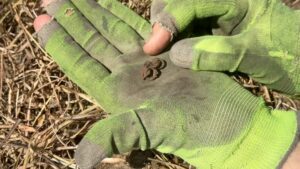
Chain mail that may have come from Spanish explorer Francisco Coronado’s 1541 expendition was found in McPherson County. Chain mail was a mesh-like type of armour.
Coronado traveled to what is now Kansas in 1541 in search of Quivira, a place he had been led to believe held great wealth. He encountered Native American communities with grass-covered houses and an agricultural society, rather than the gold he sought.
Today, Seymour’s team is looking for the physical traces of that encounter.
At the McPherson County site, Seymour said the finds include green obsidian blades, a copper bell fragment and metal fittings associated with clothing, along with chain mail. She considers the combination more persuasive than any single object.
The chain mail itself, she noted, could have been used somewhat later. Her identification rests on evaluating it with the other finds.
Researchers worked systematically with metal detectors, marking signals with flags and then narrowing the search with smaller detectors. Sometimes an object emerged only after checking handfuls of soil.
Among those who recovered the connected links were Baron Shively of McPherson and Mark Rosacker of Albuquerque, N.M.
Shively, who worked for the U.S. Department of Agriculture, said his interest in participating in archaeological digs grew after watching one in 1993.
Rosacker, a retired park ranger with a background in anthropology, had never found chain mail before. Connected links offered the researchers a chance to examine how the armor was constructed, rather than relying solely on isolated rings.
“But I’m thrilled,” Rosacker said. “I don’t even have the words to describe how satisfying this is.”
For Seymour, the arrangement of the discoveries is another part of the evidence. She said clusters of artifacts separated by relatively empty spaces resemble patterns at sites her team has studied in Arizona. She interprets those clusters as places where expedition members pitched tents and carried out daily tasks.
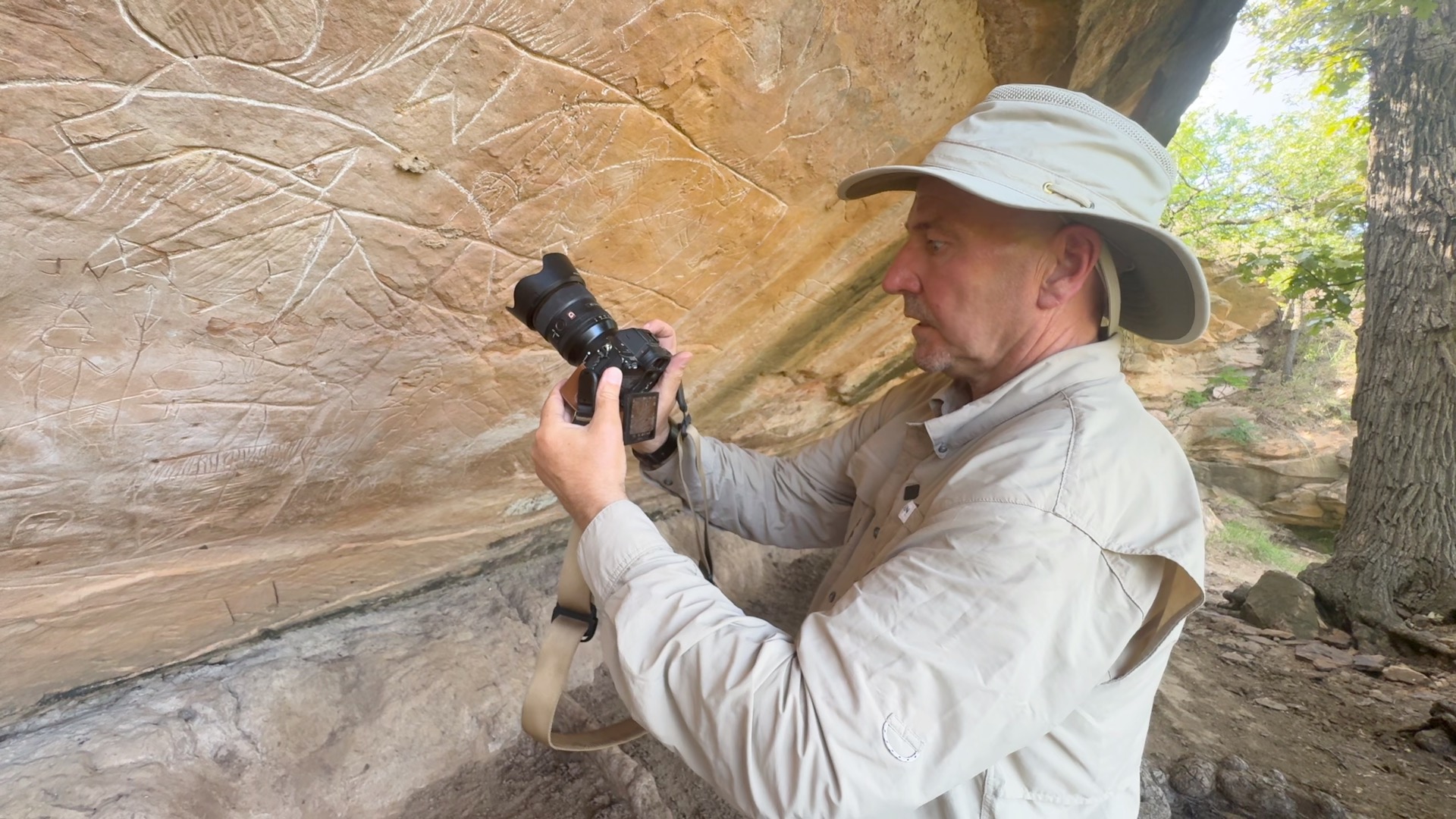
The next day’s work examined a different possible record of the expedition: images carved into a natural rock face in Ellsworth County.
The panel contains petroglyphs and inscriptions from multiple periods. Seymour believes some figures may depict Coronado’s party, including details she interprets as clothing, armor and weapons. She thinks Native Americans may have carved those images after seeing the newcomers.
That interpretation is a separate question from identifying the artifacts at the McPherson County site. The carvings’ proposed connection to Coronado depends on how the figures and their details are understood.
“This rock face really is, it’s kind of like PBS 1541,” Seymour said. “This was a newspaper from the past.”
Archaeologist Mark Willis, based in Austin, Texas, documented the panel using photogrammetry. The process combines overlapping photographs to create a three-dimensional record of a surface.
Willis said the images can help researchers see faint details and potentially recognize features they previously missed. They also establish a record against which future damage can be measured.
For Seymour, the work offers a way to explore the expedition through both the objects its members left behind and a possible Indigenous account of their arrival.
Further fieldwork is planned. During the August visit, Seymour said she expected to return in March 2027, depending on access and conditions.
She credited volunteers and cooperating landowners with making the research possible. Protecting the locations is part of that cooperation.
“Our primary goal is to explore these sites, study them and preserve them,” she said.
For now, a fragment of armor and a wall of carved images are opening new questions about an encounter that took place long before Kansas became a state.
Chris Frank is a senior producer for PBS Kansas. Contact him at cfrank@kpts.com.
A report about this archaeological fieldwork will appear on “Positively Kansas” on PBS Kansas at 8 p.m. Friday, Oct. 30, and as part of “Kansas Legends of the West” airing Tuesday, Dec. 1.