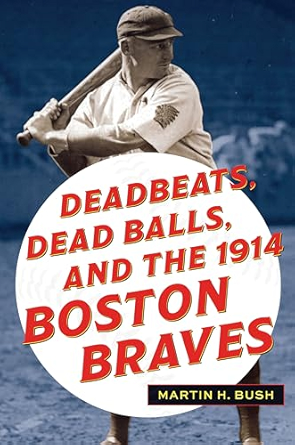
“Deadbeats, Dead Balls, and the 1914 Boston Braves,” by Martin H. Bush (The Kent State University Press, 2025, 373 pages, $32.95)
Serving as vice president of academic resources at Wichita State University, Martin H. Bush was largely responsible for creation of the Edwin A. Ulrich Museum of Art, which opened on the WSU campus in 1974. Bush was also instrumental in beginning the well-known outdoor sculpture collection at WSU that is now named in his honor.
During the Ulrich’s 25th anniversary celebration of the founding of the Ulrich, I had the opportunity to spend time with Bush, who had returned to Wichita from New York for the occasion. He mentioned to me, with some excitement, that he was working on a book about baseball. “Deadbeats, Dead Balls, and the 1914 Boston Braves” has now come to fruition.
A historian by training, Bush was introduced to the 1914 Braves through his purchase of the photo archive of Baseball magazine. The franchise left Boston for Milwaukee in 1953 and then in 1966 moved on to Atlanta, where it remains today.
Wanting to know more, Bush studied Boston newspapers on the era in the microfilm room of the New York Public Library and found the team “strangely likable. Ordinary and wonderful. They demanded attention,” in his words. He also pored over magazine articles, interviews, court records and clipping files of the Baseball Hall of Fame in Cooperstown. He visited cities and ballparks the team played in and hotels the players stayed in. First-person players’ accounts enabled him to write scenes with immediacy.
Bush writes about the game of baseball as it was in 1914, when a world war was looming in the background and the United States was still finding its place in the world.
The 1914 Braves were struggling in last place in the National League on July 4 (at the time, there were eight teams in the National League, eight teams in the American League and eight teams in the Federal League, a short-lived third league). Under the leadership of manager George Stallings and team captain Johnny Evers (as in “Tinker to Evers to Chance”), the Braves stormed back to win the pennant and advance to the 1914 World Series.
During the Series, the “Miracle Braves” defeated the American League Philadelphia Athletics, who had won three of the previous four World Series championships. Bush’s research and vivid writing allow the reader to experience the ups and downs of a Major League baseball season as if in real time.
While most of the focus is on the Braves and especially Stallings and Evers, Bush also depicts owners, umpires, newspaper reporters, fans and managers and players from other teams. All-time greats Grover Cleveland Alexander and Ty Cobb are two who make appearances.
Bush’s book was worth the wait. If you appreciate the game of baseball, enjoy American history or just have a place in your heart for the underdog, I think you will enjoy it.
Ted Ayres is a former vice president and general counsel at Wichita State University. He can be reached at tdamsa76@yahoo.com.