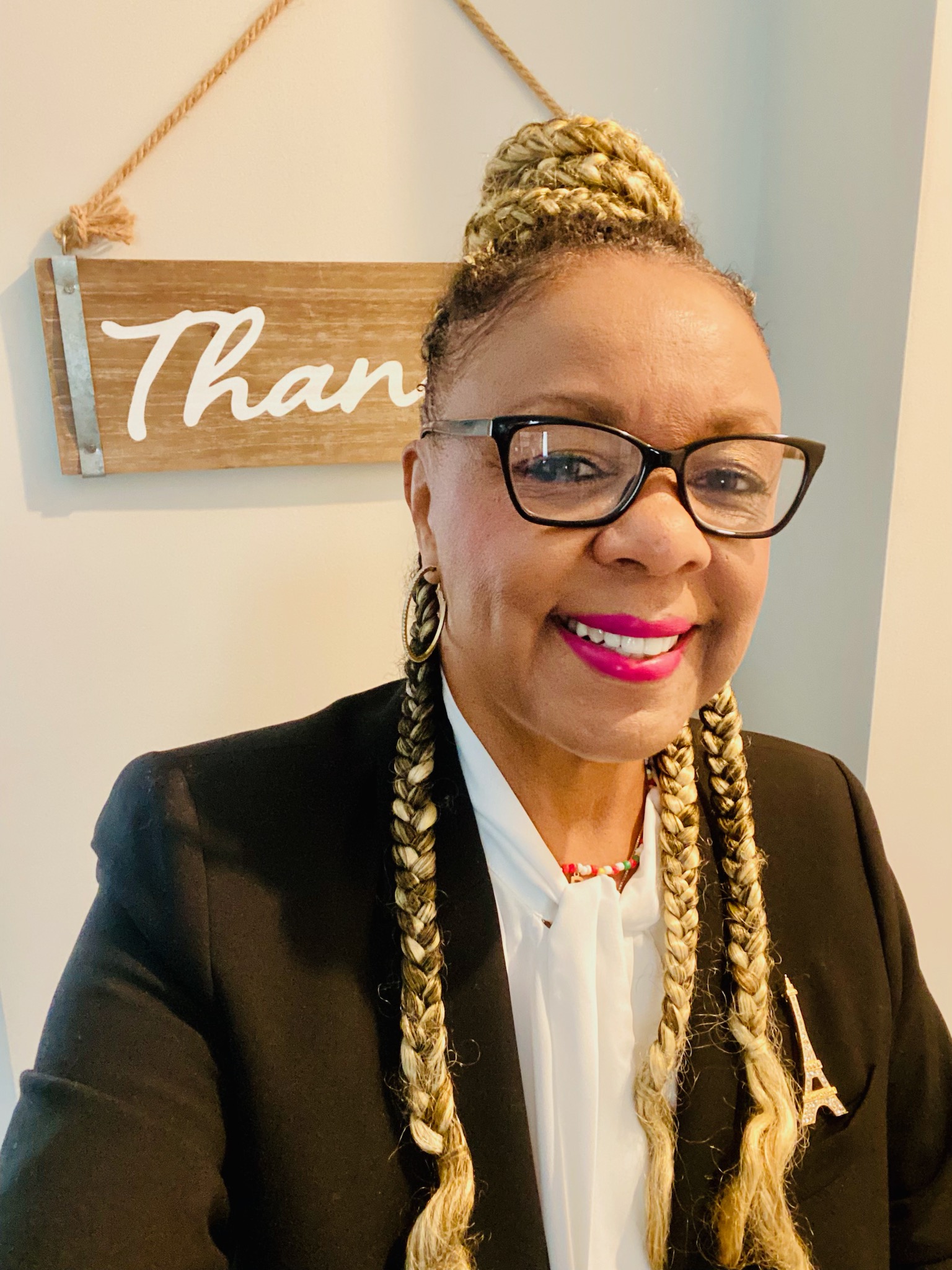
Midge Dempsey grew up in Wichita’s 67214 area code, in the north-central part of the city. She has fond memories of playing outdoors with her six siblings on warm summer days, visiting family and enjoying the camaraderie of many friends. Now, more than six decades later, she’s giving back to those same neighbors through her work with the Wichita Black Nurses Association.
Dempsey is a registered nurse who works for Midwest Transplant Network and is a 15-year-member of WBNA. Through WBNA, she’s volunteering to help carry out a $604,000 grant that the group was awarded to provide free medical testing for residents of the 67214 and 67219 area codes who may have been exposed to groundwater contamination.

Romey Bernand takes a blood sample as part of health screenings by members of the Wichita Black Nurses Association.
The contamination is believed to have happened sometime before 1994 in the Union Pacific railroad yard near 29th and Grove, probably when a solvent containing trichloroethylene (TCE) was used for metal degreasing. It entered the groundwater and spread south into a plum about 2.9 miles long, underlying an area bounded by 29th in the north, Murdock in the south, Grove in the east and I-135 in the west.
A study by the Kansas Department of Health and Environment identified nearly 2,800 homes, schools, churches and daycares in the area.
Dempsey knows the neighborhood well. It’s where she lived and raised her own family and still owns property. Unbeknownst to them, they lived, worked and played in areas possibly sitting on the contamination.

Midge Dempsey
“We were kind of in the heart of the spill, not knowing we were living on toxic ground and air,” Dempsey said. She notes that cancer — with which exposure to TCE has been linked — has affected her family. Her mother had colon cancer, her brother has prostate cancer and her sister has melanoma. While those types of cancer are not typically linked to TCE exposure, Dempsey suspects the contamination played a role.
“I really feel like it traces back to the contamination,” she said.
Free testing
Peggy Jones-Foxx, president and CEO of WBNA, said the nonprofit’s 58 members volunteer throughout the community. WBNA focuses on providing education, advocacy, leadership and health care in the Wichita community with an emphasis on helping people of color. Members include registered nurses, licensed practical nurses, respiratory therapists, anesthetists and certified medical assistants, both retired and still working.
WBNA has worked on several projects throughout its 53-year history but may have been most active during the early days of the COVID-19 pandemic, Dempsey said. While testing and vaccinations were conducted on a large scale at locations such as Intrust Bank Arena, residents of the northeast community didn’t always have transportation to receive such services. WBNA responded by establishing pop-up COVID clinics at area churches.
“We really saturated the community,” Dempsey remembers. “We’ve been hitting the pavement for quite a while. We really do work for our community.”
For the chemical spill initiative, WBNA started testing in December 2025 and will conclude by the end of this year. It is among several partners in the Clearway Testing effort, which was funded through a mix of state, local and private funds. Other organizations providing testing include HealthCore Clinic, GraceMed Health Clinic, Hunter Health and Love Clinic & Med Spa. (To find a free test, visit clearwaytesting.org) The partners are allowed to use some of the grant money to buy equipment, and the nurses association bought a van outfitted with medical equipment that is used to visit churches, community events and other sites. The free testing includes a complete blood count, metabolic chemistry profile, alpha fetoprotein measurement and a urine test. WBNA also provides blood pressure and glucose testing.
“We are doing great,” she said. “The response from the community toward us has been very positive. They are appreciative. They see people that look like them, and they identify with us and have more trust in us. We have a history of 53 years in this community and our reputation precedes us.”
Dempsey is the parish nurse for her church, St. James Missionary Baptist Church at 1350 N. Ash, in the heart of the contamination plume. She has had many conversations with congregants about the importance of testing.
“You’d be surprised how many people are coming up to me who have family members who have died from cancer. Several people have told me their doctors have told them they don’t know why their family member has this or that cancer because the family doesn’t have a history of cancer,” Dempsey said. “If we really examined all of this information under a microscope, it would probably reveal that this chemical is the cause of these kinds of illnesses.”
After being tested, individuals are called and notified of anything abnormal in their tests. If they can’t afford treatment, they are referred to another Clearway partner, Project Access, which coordinates access to donated medical care for uninsured, low-income residents of Sedgwick County.
While the test results can’t prove that any negative results are directly tied to the contamination, the process allows those tested to look proactively at their health, Jones-Foxx said.
‘Connected to this community’
The contamination was discovered by state health regulators in 1998, but remediation — which consists of extraction wells to pull up the groundwater, clean it and put it back into the ground — didn’t aggressively begin until 2023 and is likely to take 10 to 15 years. Residents of the area have complained that they were not properly informed of the contamination.
“People are angry because it was hidden from them,” Jones-Foxx said. “They are upset because this groundwater is under their houses, which causes their houses to depreciate. People have died with kidney and liver cancers.
“We have generations living in these houses who grew up drinking from the water hose, swimming in the pools, growing vegetables in the soil. They feel tricked and lied to.”
WBNA members have been impacted along with their family and friends living in the area, Jones-Foxx said.
“They are connected to this community. Many of them live here and have family, grandparents, aunts and uncles living in the community. It is important for some level of justice to be reached through free testing.”
Some Wichita residents are pursuing a class action and environmental lawsuit against Union Pacific. Filed in 2023, the lawsuit accuses Union Pacific of negligence, trespassing and concealing the contamination from the community. Plaintiffs and residents are currently seeking damages for declining property values rather than personal injury claims, which are harder to try as a class.
And while the contamination in north-central Wichita has received a good deal of attention, it is far from being the only problem area in the city. A KDHE map shows more than 200 active environmental sites across Sedgwick County.
Contact Sherry Graham Howerton at sgaylegraham@hotmail.com.