Reading is something I have always taken for granted. My mother insists I came out of the womb talking, and she swears by age 1, I was reading full sentences. While I appreciate the accolades, I’m doubting that’s true, but I don’t remember learning to read ever being a problem.
But for millions of Americans, reading is not so easy. Challenges such as illiteracy or dyslexia silently plague the population, making it difficult for some to even apply for a job, much less possess the skills to build a career.
So how many Americans are illiterate? The answer depends on how you define “illiterate.” The U.S. government generally measures literacy proficiency rather than simply labeling people illiterate.
According to the National Center for Education Statistics, 28% of U.S. adults ages 16 to 45 performed at Level 1 or below in literacy. That is one in four working-age adults. However, Level 1 does not mean all of these people are completely unable to read. It means that they have difficulty with relatively basic reading tasks.
A person who scores below Level 1 is closer to what is commonly meant by functionally illiterate, meaning they have difficulty understanding sentences, finding a single piece of information in a short text or completing simple forms. An earlier NCES study estimated 8.4 million adults were below Level 1, with another 26.5 million at Level 1. And in Sedgwick County, one in five adults test at Level 1 literacy or below.
Dyslexia is another story. Estimates vary because dyslexia exists on a spectrum and many people are never formally diagnosed. The best supported estimates for the United States suggest 5 to 10 percent of Americans have dyslexia, which translates into 20 to 35 million people. Interestingly, dyslexia does not mean someone is illiterate. Many people with dyslexia learn to read accurately, although they may read more slowly, have difficulty decoding unfamiliar words or continue to have spelling and writing difficulties throughout adulthood.
Not enough help
So, between illiteracy and dyslexia, reading issues affect a significant portion of the population. I learned more about this after recently visiting an event hosted by the Wichita Journalism Collaboration, a local coalition of 11 newsrooms and community groups, of which The Active Age is a member. WJC has recently launched “Beyond Words: Wichita’s Reading Crisis,” an initiative to raise awareness about the challenges faced by adults who struggle with reading. It is especially noteworthy that this initiative focuses on adults, because while there are services for children who struggle to read in school, adults who are unable to read often
fall through the cracks.
“Our goal with this initiative is to, one, educate the community that this issue of illiteracy in adults exists, and, two, we would love that through this initiative solutions would be created,” said Kathy Lefler, project manager for WJC. “There are just not enough programs to help them.”
During the kickoff event last month, staff from the Phillips Fundamental Learning Center — a nonprofit organization in Wichita dedicated to helping children with dyslexia and reading challenges through structured literacy instruction, educator training and specialized student programs — and the Wichita Public Library met with an audience of individuals interested in learning more about this issue. The team led simulations that allowed participants to experience the challenges faced by individuals with dyslexia, dysgraphia (a neurological learning disability that impairs a person’s ability to write legibly, spell consistently and express thoughts on paper) and other learning challenges.
Humbling experience
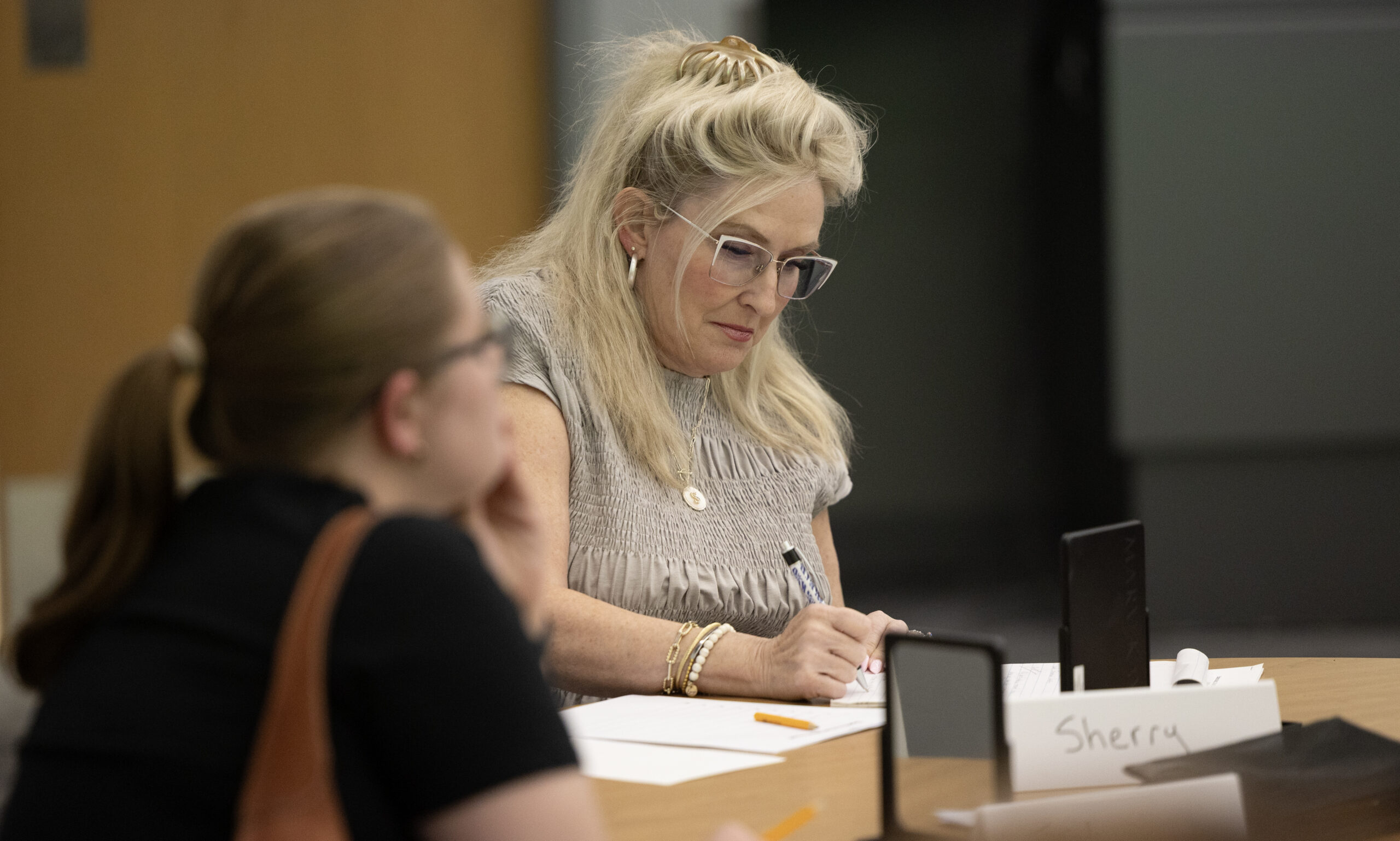
I was able to attend this event and participate in the simulations. It was a humbling eye-opener for me.
Jill Hodge, a PFLC Ambassador and Facilitator, led four exercises that immersed the audience in the struggles an illiterate or dyslexic person faces. In the first exercise, participants took a spelling test dictated on an audio recording that shows the difficulty a dyslexic person has in discriminating between sounds in words. There were 10 words given. Because I could not understand the audio recording, I did not get one of them right.
In another example demonstrating dysgraphia, a visual-motor task simulated the difficulty in writing letters when you don’t have kinesthetic-motor memory for the sequence of movements needed to form each letter. The task was to draw a star by looking at your covered hand in the reflection of a mirror and after trying for several minutes, I could not do it. My star was just a series of squiggly lines. More failure.
A final exercise led by Steven Kelly of the Wichita Public Library simulated an adult trying to fill out an online job application when they could not read the words (for the sake of this exercise, the words were printed in Dutch). I left most of the 10 questions blank because I could not figure out what information was needed – I could not understand the questions because I could not read them.
Words of despair
Many words of despair went through my head as I attempted these exercises, and many feelings came to the surface. I felt embarrassed that I could not complete the tasks at hand. I felt frustrated that I could not decipher what felt like “codes” to get the answers right. And I could imagine how an illiterate adult might feel angry, discouraged and depressed over the inability to communicate in a world where reading and writing are absolute necessities – and for me, reading and writing make my living.
And even if I didn’t have a career in journalism, this simulation brought to mind the many ways it would be nearly impossible to function in society if you can’t read, spell or write. Reading is in everything we do, from reading a street sign to paying our bills to enjoying a great newspaper read like The Active Age! If you cannot do these things, you often come across as low intelligence when in fact, that is not the case. You just haven’t been given the tools to succeed.
“Illiteracy affects every part of a person’s life,” said Hodge. “That’s why early intervention is huge.”
And for children, more resources are available through the school system and other programs. But for adults, the options are extremely limited.
“There is a real dearth of resources in Wichita,” said Kelly. “That’s what this collaborative is trying to get across. It’s a big, wicked problem. And it’s not just in Wichita, it’s national in scope.”
Hodge says that when the right tools are given, however, adults can still overcome dyslexia and illiteracy.
“It’s never too late to learn,” she said.
For more information on Beyond Words: Wichita’s Reading Crisis, contact Kathy Lefler at 316-712-4960 or klefler@kansasleadershipcenter.org. For information on the Phillips Fundamental Learning Center, which offers simulations like those that were hosted at the kickoff event at its offices in east Wichita, contact Jill Hodge at 316-684-7323 or jhodge@funlearn.org.
Reach Sherry Howerton at sgaylegraham@hotmail.com.