PIQUA, Kan. — Just inside the front door of Rural Water District #1 headquarters, there’s a lady behind a wooden desk. She’s talking to someone on the telephone. She sizes us up, decides that we aren’t locals with a water problem, and points at the door to a darkened room.
“The museum’s there on your right,” she says. “Just flip on the light, and go on in.”
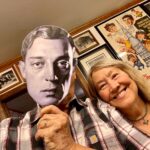
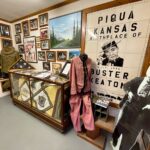
We follow her instructions and find ourselves inside a one-room Buster Keaton Museum, chock full of memorabilia. It may seem odd to find a silent movie star museum in the tiny town of Piqua, Kan., but there’s a good reason. Buster Keaton was born here just a few yards from the museum. Buster’s parents weren’t natives of this state, but we can thank a Kansas tornado for the timing and location of Buster’s birth.
In 1895, Joe and Myra Keaton were traveling the country with the Mohawk Indian Medicine Company, a vaudeville show that sold patent medicine on the side. As The Two Keatons, Joe performed acrobatic comedy sketches while Myra played the saxophone. On Oct. 4, 1895, the company had stopped in Piqua and had set up their tent for a show the following day. But as dark clouds began gathering and the wind picked up, the heavily pregnant Myra decided that she should take shelter in a local rooming house.
The storm turned out to be a tornado. It blew away the company’s tent, battered the rooming house with flying debris, nearly destroyed the tiny town and terrified the expectant mother. After the winds died down, Joe went out to search for the tent while Myra tried to calm herself from the experience. By the time Joe returned, Myra had given birth to a future silent film star.
They named him Joseph Frank Keaton after his dad and his maternal grandfather. By the time he was 3, the toddler had become part of his parents’ touring vaudeville act. After The Two Keatons became The Three Keatons, Joe and his young son performed increasingly dangerous slapstick routines while Myra played the sax. It became known as the roughest act in show business. Joe would hurl the toddler against the stage scenery, into the orchestra pit, even into the audience. The comic pratfalls always got bigger laughs when the toddler got back to his feet with a deadpan look. Keaton claimed he was never hurt because he knew how to land. “Several times I’d had been killed if I hadn’t known how to land like a cat,” he said.
One night, the young Keaton solemnly deadpanned the crowd after a tumble down an entire flight of stairs. The theater roared and fellow performer Harry Houdini exclaimed, “Man, that was a real buster!” The nickname stuck, even if historians disagree about who coined it.
Buster Keaton moved to Hollywood in the early 1920s, performing even more dangerous stunts in a successful series of two-reel comedies. As he’d done as a child on stage, Keaton looked at the camera without any facial expression after each near-death experience. The deadpan look became his trademark and earned him the nickname The Great Stone Face.
There are dozens of photos and movie posters from that era in the Piqua museum, including shots of Keaton and Roscoe “Fatty” Arbuckle. The portly Arbuckle was already an established comic actor when Keaton got to Hollywood and landed a minor role in one of Arbuckle’s comedies. Keaton impressed the star with his inventive sight gags, and Keaton’s own career took off after he became Arbuckle’s assistant director and chief gag writer. The two became close friends. Besides a love for physical comedy, they also had something else in common. They were both born in Kansas. Roscoe Arbuckle entered the world in 1887 in Smith Center, weighing more than 13 lbs. Both parents were native Kansans and no tornadoes were involved.
Buster Keaton, of course, went on to become a far bigger star than Fatty Arbuckle. Six of his films have been included in the National Film Registry, and film critic Roger Ebert called Keaton “the greatest actor-director in the history of movies.” In 1959, Keaton was presented with an honorary Oscar at the Academy Awards — a recognition of his achievements as an actor, a director and a legendary pioneer in silent comedy. So he’s well deserving of a humble little museum in the town where he was born.
Aside from the museum, several huge grain elevators and a three-legged collie who stares suspiciously at strangers, there’s not a lot to see in Piqua. It’s a tiny farming community about two hours east of Wichita on Highway 54 (eight miles west of Iola), and it’s pronounced “Pick-way.” You’ll need to get that right or the lady behind the desk at the water department will spot you immediately as an out-of-towner.
The museum is open 8:30 a.m. to 2 p.m. most Tuesdays and Thursdays. Admission is free, but after you see the creepy stone-faced Buster Keaton life mask, you’ll want to stuff a few bills in the donation box. And if you spot a tornado on the horizon, like Buster Keaton’s parents did, don’t worry. There’s a steel storm shelter just a few steps away from the museum.
Joe Norris is a retired Wichita marketing executive. He can be reached at joe.norris47@gmail.com.