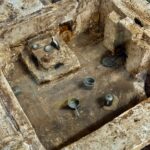
PRATT — In the 1870s, a trapper named Johnson was one of the few residents of Pratt County. Digging into the yellow clay and gypsum along the Ninnescah River near where the town of Pratt now sits, Johnson excavated a cozy two-room cave from the side of the riverbank. In good weather, he trapped bobcat, coyote, beaver and skunk. In bad weather, he stood over the fire in his cave, rendering oil from the fat of the skunks he’d caught.
Back in frontier times, skunk oil was thought to possess certain medicinal properties that were highly valued. So a few times each year, Johnson made the long ride to Wichita to sell the oil he’d rendered along with the pelts he’d skinned. Johnson’s skunk oil was said to be odorless. But the same could not be said about Johnson himself.
“If Johnson arrived in Wichita after nightfall, his presence in town was known, for the passing breezes wafted the odor of the skunk from his clothing into the homes and stores before his arrival,” according to a 1911 article in the Topeka Daily Capital.
As he was returning to the cave from one such trip in 1874, a band of Indian warriors began to pursue him. Johnson said he knew that they meant to kill him. Perhaps he was trespassing on their tribal land. Or maybe he was just polluting their air with his skunk-odor presence.
“There were 20 of the braves, all decked out in war paint,” the 1911 newspaper story continued. “Johnson knew that he must ride for his life, and, throwing away the load of supplies he had purchased in Wichita, he rode for his life toward the cave.”
Johnson got there seconds before his pursuers, turned his pony loose and barricaded himself inside the cave. For 15 days, the Indians attempted to starve him out. But Johnson outlasted them. He had spring water inside the cave, and he also had a food supply.
“I was compelled to eat the meat of skunks to keep alive,” Johnson explained in 1911, when he returned to the site of his old cave nearly 40 years after the incident.
If you’re like most Kansans, the main thing you know about Pratt is that it has two water towers labeled Hot and Cold. They’re still here, standing proudly on North Main. But there are three less obvious attractions in Pratt that make it well worth a day trip.
The first hidden treasure is the Pratt County Historical Museum, where you’ll see a scale model of Skunk Johnson’s cave. Don’t worry, the model is completely odorless. But you may find yourself trying to avoid inhaling as you look down into the primitive home that Skunk occupied 150 years ago.
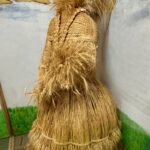
The museum is much larger than you’d expect, completely filling two stories of an old lumber yard. You’ll see everything here from a pioneer’s sod house to a disk jockey’s AM radio studio. There’s a life-size woman made entirely of wheat straw. There’s a collection of toasters flaunting more chrome than a classic car show. And since Pratt has been home to the annual Miss Kansas pageant since 1955, most of the museum’s second floor is dedicated to the women who have represented our state in the Miss America Pageant.
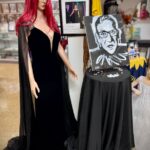
Numerous formal gowns, swimsuits and elaborately decorated shoes are displayed — along with a scowling portrait of Ruth Bader Ginsberg created on stage by Miss Kansas 2019-2020 for her part of the talent competition.
The second secret treasure in Pratt is one that was actually TOP SECRET in 1942. During World War II, the Pratt Army Air Field was used to train crews for the B-29 Superfortress bomber. A key part of the training was how to operate and maintain the highly classified Norden Bombsight. A complex electro-mechanical analog computer, the Norden guided bombers to precise drop locations from high altitudes. Army Air Force officers boasted that the bombsight could “drop a bomb into a pickle barrel from 30,000 feet.” So the Army went to great lengths to shroud that advantage in secrecy.
When each B-29 landed, the Norden was immediately removed and secured in a concrete bunker. Armed guards stood outside the bunkers to prevent the Nordens from falling into enemy hands. Several of the bunkers are still standing at the old airfield today. And an actual Norden Bombsight is on display in the Parachute Building of Pratt’s B-29 Museum. An exhibit of “nose art”that adorned B-29s is also scheduled to open at the Vernon Filley Art Museum here July 18 and run through the end of the year.
Pratt’s third hidden treasure isn’t actually hidden at all. It’s printed on a small green sign at the edge of town: “Welcome to Pratt, Boyhood Home of Bill Farmer, the Voice of Goofy & Pluto.”
Voice actor and impressionist Bill Farmer was born in Pratt in 1952. He began doing character voices at the age of 10. He would sometimes entertain his friends by going through fast-food drive-throughs and ordering food in the voice of John Wayne or Walter Brennan. In 1986, Farmer got a call from Disney to audition for the character Goofy. He prepared for the audition by studying the voice of Pinto Colvig, the original actor who created Goofy’s signature laugh and his “gawrsh” exclamation. Farmer got the job and has been doing the voice of Goofy ever since. He also inherited the somewhat less-challenging role of Pluto in 1990.
Farmer has been named a Disney Legend, but he doesn’t work exclusively for Walt’s studio. Over the years, he’s been tapped by other studios to do voices for Sylvester the Cat, Scooby-Doo, Yosemite Sam and characters from animated movies like “The Lorax,” “The Grinch” and “Cars.”
Someday, one of those studios might decide to do a feature-length animated movie about the history of Pratt, Kansas. Bill Farmer would do all the voices, of course. Because who is better qualified to recreate the unique dialect of Pratt County pioneers than the guy who grew up within sniffing distance of Skunk Johnson’s cave?
If you go
Pratt County Historical Museum, 208 S. Ninnescah, (620) 672-7874, open 1-4 p.m. Mon.-Fri., 1-3 p.m. Sat.-Sun. Admission $4 for adults, $2 for kids 12-18, free under 12.
B-29 Museum, 82 Curran Road, about 5 miles north of Pratt. Open 2-4 p.m. Sundays or by appointment. Call (620) 672-1944. Old concrete bunkers are open to the public at any time.
Vernon Filley Art Museum, 421 S. Jackson, (620) 933-2787. Admission $4 for adults, $3 for seniors, college students and teachers, and $2 for youths 5-17.
Joe Norris grew up on a farm outside Pratt but says he didn’t know about many of these things until returning for a recent high school reunion. Contact him at joe.norris47@gmail.com.
Note to readers:
Joe Norris’s previous stories about day trips around Kansas are available on our website. To find them, go to theactiveage.com and type in “Joe Norris” in the Search box in the upper right corner.