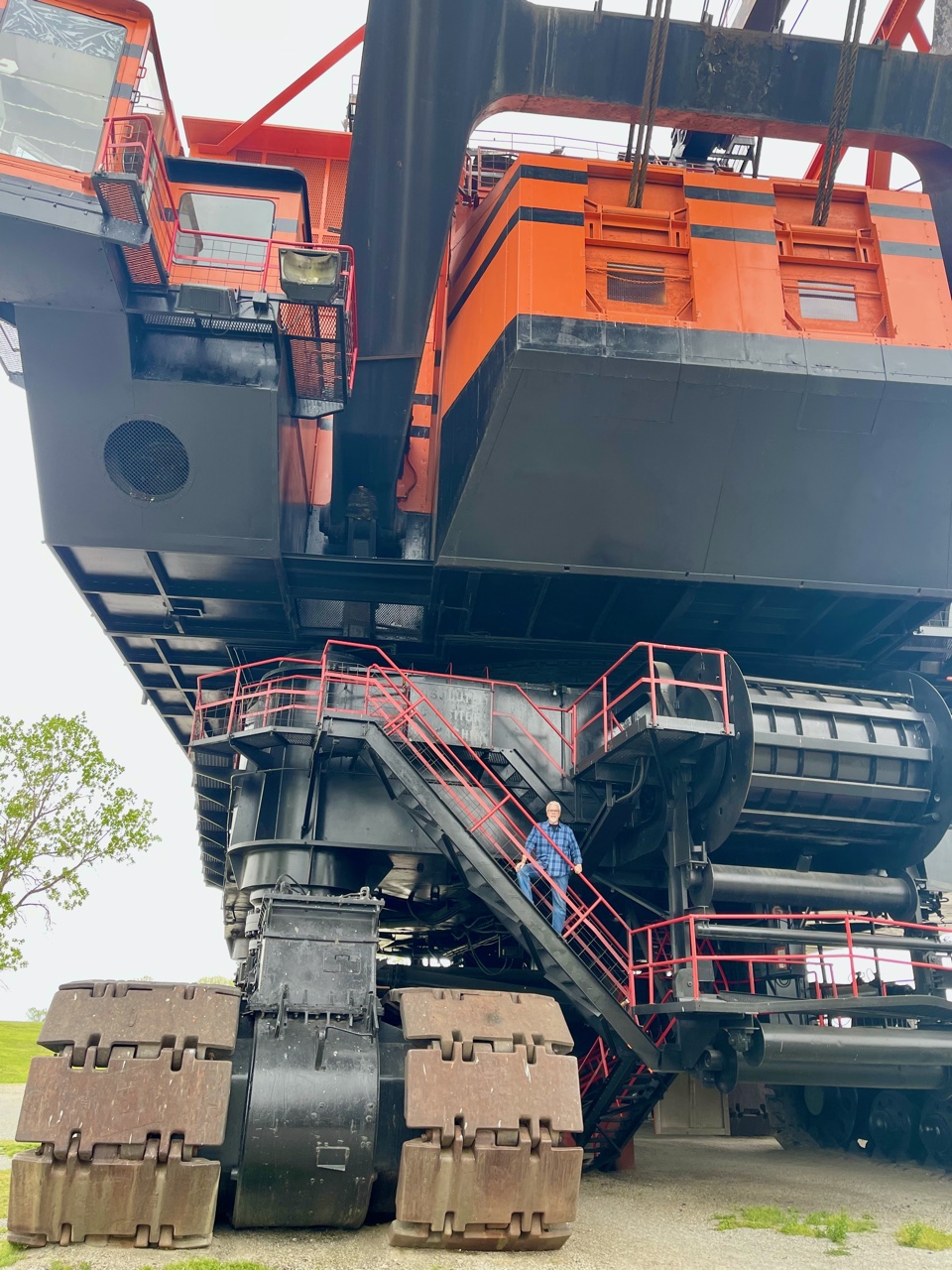
PITTSBURG — Looking up at a machine that stands 160 feet tall and weighs 9.3 million pounds, one realizes that calling it Big Brutus is inadequate. And that’s why people still drive to the southeast corner of Kansas, in what was once King Coal Country, to see the gigantic powered shovel. It’s the centerpiece of the Big Brutus Museum in West Mineral, about 20 miles southwest of Pittsburg.
Big Brutus didn’t actually mine coal. It removed overburden — the layer of rock and dirt covering coal seams that were hidden 20 to 70 feet below the surface. The colossal shovel traveled in a straight line, digging a 120-foot-wide trench. When that trench was a mile long, Brutus would pivot and begin digging a parallel trench in the opposite direction. A crew of bulldozers, loaders and trucks followed behind to extract the newly-exposed coal.
Put into operation in the early 1960s, Brutus was a far cry from how coal had been mined here back in earlier days, when miners removed the overburden with picks and shovels, mules and wagons. Just after the Civil War, railroad expansion rapidly transformed the United States, and the old locomotives gobbled tons of coal. There was so much work for experienced miners in Bourbon, Cherokee and Crawford Counties that immigrants would step off the boat at Ellis Island and head straight for the Sunflower State. Powered by a workforce from Germany, Italy, Poland and the Balkans, coal production exploded in Southeast Kansas and kept growing, year after year.
In 1934, miners and their families threw a King Coal Festival to celebrate the region’s rich coal reserves and its ethnic diversity. There were parades, concerts and picnics. To learn a little more about what life was like here in those days, we head over to the Crawford County Historical Museum in Pittsburg. We’re greeted by a white-haired volunteer in a kilt.
“Is there a Scottish festival in town today?” I asked.
“I’m the Scottish festival in town every day,” he said with a smile. “Both my parents were Scottish, and all my life, I wanted a kilt. I got my first one a couple years ago, and now I have seven!”


The museum is crammed full of interesting artifacts. There’s a two-headed calf. A bowling-ball-sized hairball extracted from the stomach of a local cow. An ancient X-ray machine that may or may not have been able to detect cases of black lung. And the red chiffon velvet gown that Maxine Thompson Brazil wore that night in 1934 when she was crowned Queen of the first King Coal Festival. It seems like the whole town was there to celebrate, except for “Chicken Annie” Pichler.
Pilcher was at home, wearing a faded cotton dress and frying chicken at her kitchen stove. Her husband, Charlie, had lost a leg in a mining accident the year before and was no longer able to work. So Annie became the family breadwinner. She served chicken lunches for miners in her kitchen at noon, then moved furniture out of her living room to accommodate the larger dinner crowd at night. Word spread, the crowds grew, and Annie eventually moved Chicken Annie’s Restaurant out of her house and into its own building.
It’s still there, and we drove over for dinner. It still follows Annie’s fried chicken recipe, and her portrait is still proudly displayed on the wall. One bite, and it’s easy to see why Chicken Annie’s is still thriving in Pittsburg after 93 years. So is Chicken Mary’s, a friendly rival that sits next door. It started in 1942 when Mary Zerngast began frying chicken after her husband was no longer able to work in the mines. Both restaurants serve potato salad and coleslaw lovingly made from recipes brought over from the Old Country by the wives of coal-mining immigrants.
Exactly 40 years after that 1934 King Coal Festival, the mining company determined it was no longer economically feasible to continue clawing coal out of the Southeast Kansas landscape. So in 1974, they pulled the plug on Big Brutus. Yes, Brutus was electric. When retired, Brutus was gobbling $28,000 of electric power each month. Today, that would be about $190,000.
Big Brutus originally came to Kansas in pieces, on
150 railcars. It had taken 52 men eleven months to assemble the enormous shovel, and it would have been an equally huge task to disassemble and move it. So the mining company simply left Big Brutus in the spot where it had scooped up its last load. The museum opened in 1985.
“Except for a brief pause to change out the hoist cables every six months, Big Brutus worked nonstop, all day and all night for 11 years,” said Cody Morris, Director of the Museum. “It completely transformed coal mining here, making the operation far more efficient and far, far safer than back in the old days.”
There’s little evidence of those old days in that corner of Kansas now. The deep ditches and high ridges left by strip mining are now rolling hills and fishing lakes, operated by the Kansas Department of Wildlife and Parks. But there are still reminders of the people who came straight to Kansas from Ellis Island to seek their fortunes in the coal mines.
“The original immigrants planted lots of garlic and onions in their gardens,” Cody tells us. “Some of that garlic is still growing wild in my yard today.”
Big Brutus is not the largest electric shovel ever built, but it’s now the largest one still in existence on the planet. It has earned a place on the National Register of Historic Places. And it’s a gigantic reminder of the days when King Coal reigned supreme in this corner of Kansas.
Contact Joe Norris at joe.norris47@gmail.com.
Big Brutus Museum
6509 NW 60th St
West Mineral, KS
Open 9 am – 5 pm daily
Admission $9 for seniors
$10 for adults, $5.50 for kids
Crawford County Historical Museum
651 South US-69, Pittsburg, KS
Open 10 am – 3 pm Wednesday through Saturday
Free admission
Chicken Annie’s
1143 E. 600th Ave.
Pittsburg, KS
Pichlerschickenannies.com
Chicken Mary’s
1133 E 600th Ave.
Pittsburg, KS
Chickenmarys1942.com