Editor’s note: This year, as the United States of America celebrates 250 years of liberty, we are honored to share excerpts from a new book: “They Gave All For Freedom.”
The book tells of a Czechoslovakian family who immigrated to the United States 75 years ago after living under the Nazi regime, Communist Russia’s occupation, in prisons and in displaced- persons camps.

Susan Armstrong, left, and Vlasta Honolka tell the story of Honolka’s family in “They Gave All For Freedom.”
In the spring of 1942, Czechoslovakian resistance fighters killed Reinhard Heydrich, the head of Hitler’s Security Service who was known as “The Butcher of Prague.” Hitler retaliated by ordering the annihilation of all occupants of the Czech village of Lidice. Nazis filmed the carnage and forced people to watch it. Later that summer, on July 7th, 1942, Jarmila Honolka gave birth to her second daughter, Vlasta.
As a mother of three children under the age of five, Jarmila worried that Hitler’s soldiers would come knocking on their door next. She gathered her children near and refused to let them out of her sight. Lidice was only 90 miles from Nova Paka, where the Honolkas made their home at the time. If this could happen to an entire town, what might the Germans do to her own children?
German troops with barking dogs conducted random searches of Nova Paka neighborhoods at all hours of the day and night. One night, just after midnight, soldiers pounded on the Honolkas’ front door.
Jarmila woke to the sounds of crying. She ran to gather her children. Eva and Lada clung to her nightgown. She carried baby Vlasta in her arms.
“Öffne die Tür!” the Nazis shouted. John pulled on his pants and rushed to the door. Two soldiers lined the family up against the wall and held them at gunpoint while others searched the house. Staring into the barrels of those guns, Jarmila and the children were terrified. If the Nazis discovered anything suspicious — radios, ammunition or extra food —the penalty was immediate death.
The raid lasted only minutes, but the men left Jarmila’s neat little house in disarray. John and Jarmila were grateful the Nazis missed one item in their search: a radio hidden in the attic.
“It was all for show, Jarmila,” John said. “They only wanted to frighten us.”
Tears trickled from Jarmila’s eyes. After the Nazi raid of her own home in Nova Paka, the young mother feared Hitler more than ever.
***
When WWII ended, John Honolka was filled with optimism; he started his own wholesale pastries factory. But Soviet Russia had assumed control of Czechoslovakia. Soon, they demanded that John declare his allegiance to the Communist Party, with his business to become property of the state. He refused. Vlasta was six years old when she and her family attempted to flee their homeland in search of freedom.
Shortly before their arrival at the Hungarian border, the driver pulled onto a dirt road that led to a long field and a farmstead. They came to a stop beneath the trees. The taxi driver said, “This is as far as I go. Across the field is the farmhouse where you need to go.”
The family climbed out of the taxi. Olda (Jarmila’s older brother, who also went with them) pulled out the envelope and retrieved a flashlight from beneath the seat of the car. He shuffled through the papers, checking the names and ages on each one. Then he began again.
Olda’s hands shook as he counted. He turned to John. “We’re one document short.”
“That’s impossible,” John said. “We paid for seven.”
“This is my fault. I should have checked them at the handoff,” Olda said.
John shook his head. “There wasn’t time. You risked everything to pick them up.”
Olda shoved the envelope into John’s hands. “You go without me. I’ll go back with this driver. You meet our next contact, up ahead.”
“No. We all go together. If someone questions us, we will say we haven’t yet received identification papers for Johnny, the baby.”
“It’s too risky. You and your family must go without me,” Olda said. “I’ll join you later.”
John grabbed Olda by his shoulders. “If you don’t come now, you may never get out.”
Jarmila and Eva gathered the children into the shadows at the edge of the field. Jarmila swaddled John, Jr. in a sling across her chest.
The night was pitch black as the family walked through the long field of cut wheat. No one was to speak, even in the darkness. The only sound was the crackling of dried wheat as they walked silently through the stubble.
The family made their way by foot across the field to an old farmhouse where a large woman greeted them warmly. But luck was not with them that morning. The Hungarian woman refused their paperwork. “It will not pass inspection,” she said.
Immediately, she called out to the police, who were nearby. “Over here! They are trying to escape.”
The arrest was quick. The officers aimed their pistols at the family. John raised his hands in the air. Jarmila stood beside him. “We have children here,” she shouted.
The officer’s eyes flicked to the baby Jarmila carried in her arms.
Eva, Lada and Vlasta lined up between John and Jarmila.
Their attempt to escape had failed.
***
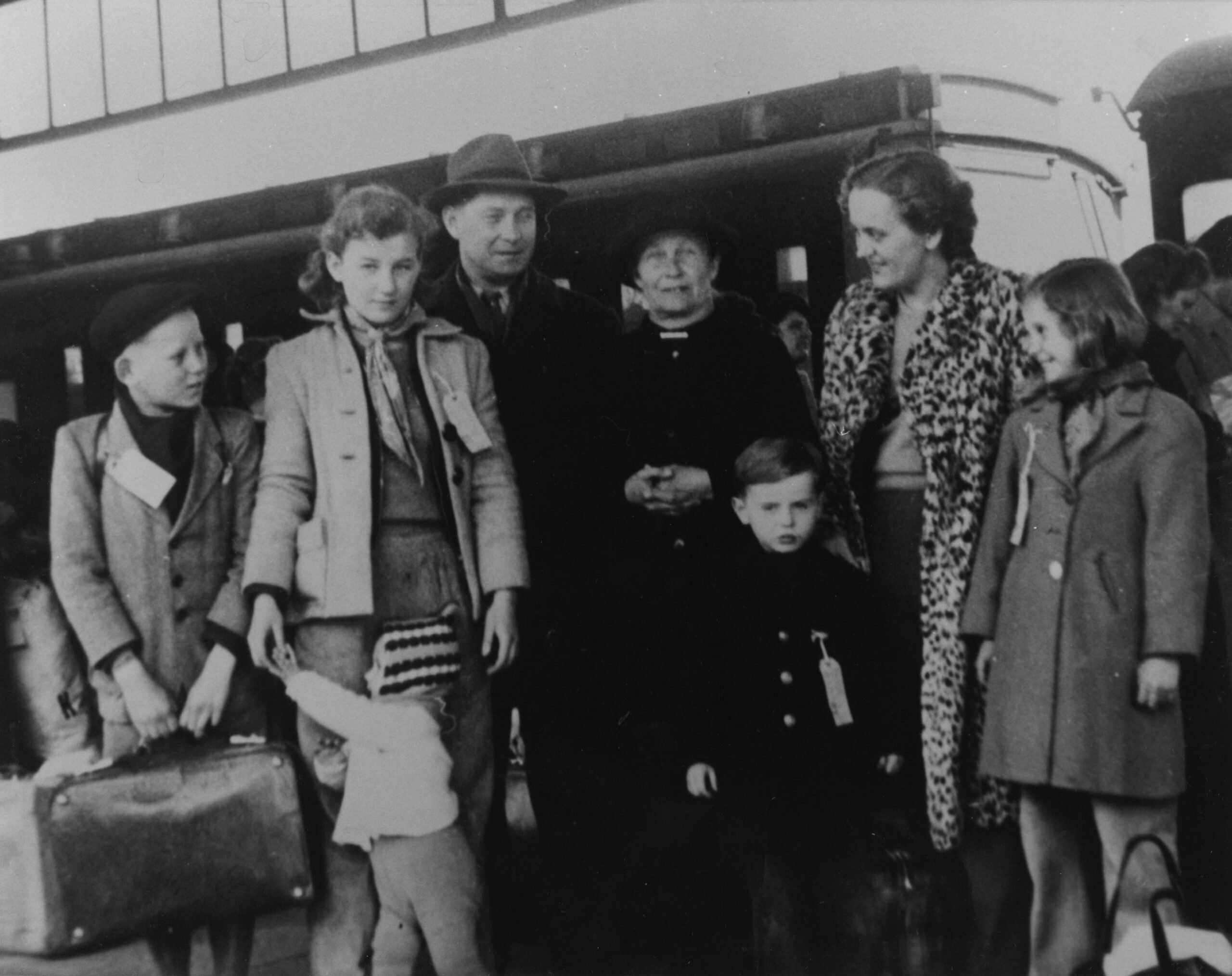
Following several more years in prison and displaced persons camps, the Honolka family, now with five children, immigrated to the United States.
After a two-week voyage on the open seas, they arrived at the port of New Orleans on April 26, 1951. Their trip was one of more than 30 humanitarian transatlantic voyages the USS Harry Taylor would complete in the years following the war.
Jarmila’s legs wobbled beneath her as she walked onto the gangplank carrying Thomas. Behind her, Lada dragged their one small suitcase. Eva and Vlasta followed next. John held John Jr. by the hand. Workers would unload their medium-sized faded red wooden crate later and take it to the train station. All wore broad grins when their feet hit the pavement at the Port of New Orleans.
“This is America,” John said, “but it isn’t where we will stay. Our land of opportunity is north of here, in Iowa. We will go there by train.”
***
In time, all seven of the Honolka immigrants became naturalized citizens of the United States of America. As adults, they flew the American flag with pride and spoke of their adopted nation with gratitude. The oldest of the children, Eva, devoted her life to carrying the torch of freedom, speaking at hundreds of gatherings and building bonds of cooperation between the USA and Czechoslovakia. On one occasion, she was awarded the Cross of Merit medal by the Czech Minister of Defense.
Now a 78-year-old grandmother, she spoke confidently from the podium in her melodic Czech accent, repeating the message she never tired of sharing.
“We gave everything. We gave our heritage. We gave our language. We gave everything, for an intangible called freedom, that this nation gave us.”
Her blue eyes blazed with passion.
“It is my utmost obligation — till I take my last breath — to pay back to a nation that so graciously adopted us.”
Adapted from “They Gave All For Freedom” by Susan Armstrong and Vlasta Honolka. Contact Susan Armstrong at susan.armstrong7@gmail.com.
 Book talk
Susan Armstrong and Vlasta Honolka will discuss and sign copies of “They Gave All For Freedom” at 6 p.m. Thursday, July 23, at Watermark Books & Café, 4701 E. Douglas. The event is free but reservations are required. Call Watermark at (316) 682-1181.The book is currently available through Amazon, Barnes and Noble and Watermark Books.
About the Authors
Susan Armstrong is a retired advertising agency owner, former member of The Active Age Board of Directors and author who writes the Josie Posey mystery series under the pen name Anna St. John.
Vlasta Honolka is a retired Registered Nurse who lives in Augusta. This is the first time she has shared her story with anyone. She is a reader of The Active Age.