If only all wars could be as short and sweet as the Spanish-American War. Relatively speaking, of course.
Hostilities between Spain and the United States commenced in April 1898, and Spain capitulated in August. There was bloodshed, suffering and death on both sides. But the gains to our nation were monumental.
On a global scale, the United States forsook isolationism and became a world power, gaining territories, markets and wide-ranging influence in the Caribbean, Pacific and Asia.
At home, the conflict helped heal wounds left from the Civil War as northerners and southerners fought side by side. It raised the status of black Americans due to their willingness to volunteer for the war, although they remained thought of as second-class citizens in many respects.
Secretary of State John Hay called it a “splendid little war,” and it’s viewed as helping usher in the “American Century” that followed.
The war had two main causes: Americans’ objections to Spain’s treatment of its colonies in Cuba and the Philippines and the sinking of the American warship USS Maine in Havana Harbor in February 1898.
After decalaring war, President McKinley issued a call for volunteers. Four regiments of Kansas volunteers eventually formed. None saw combat against Spain, but two saw duty overseas in the war’s immediate aftermath.
Fighting Filipinos
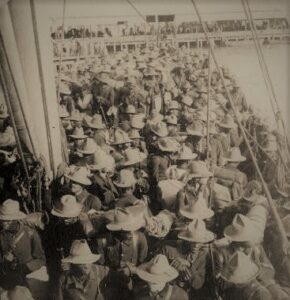
Members of the 23rd “Colored” Volunteer Infantry boarding a ship.
The 20th Kansas Volunteer Infantry unit was sent to the Philippines to battle Filipino rebels who, having previously fought Spain, wanted their country to be independent rather than a colony of the United States. The 20th — and especially its leader, Gen. Frederick Funston, who was from Iola — gained fame for its daring capture of Filipino revolutionary leader Emilio Aguinaldo. “Fighting Fred” Funston was one of the war’s three Medal of Honor winners from the Sunflower State.
It doesn’t appear that many members of the 20th came from the Wichita area. According to one website devoted to the Spanish-American War, only three veterans of the 20th are buried in this area. John F. Quick, a corporal who died in 1961, and John Hancin, a wagoner who died in 1949, are buried in Wichita. According to one history of the 20th, Quick was sent home sick during the war, a common occurrence. John Lander, a private who died in 1954, is buried in Newton. It’s likely that others from this area are among the many veterans of the 20th buried in Leavenworth National Cemetery.
‘Colored’ volunteers petition
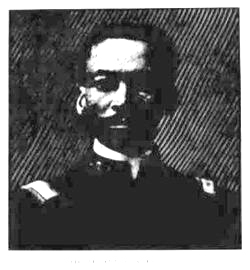
William Bettis, who asked Gov. John Leedy to accept black volunteers for the Spanish-American Wa
The other unit of volunteers who saw duty overseas had to fight just for the opportunity to serve their country. This was the 23rd Volunteer Infantry, made up of what were then generally called “colored” soldiers.
In May 1898, Wichitan William Bettis telegraphed Kansas Gov. John Leedy asking if he would accept the service of black volunteers from Sedgwick County. “The colored men of this country are as patriotic as their white brothers, and have just as much interest in the welfare of the country as any one possibly can have,” the Wichita Eagle reported on May 26, 1898. “During the civil war they fought for their liberty; now their sons are coming forward in the defense of the United States and Cuba.”
The Eagle went on to say: “So far as now, this is the first case in the United States where a company of colored men have asked to give up their homes and friends and the pleasures of life to go to the front to endure hardships and fight for their country.”
Kansas eventually became one of eight states to field companies of black volunteers, and one of only three whose officers were black.
The 23rd was mustered into service in Topeka in July 1898, consisting at the time of 29 officers and 850 enlisted men, including 84 from Wichita-based Company E. Many more who wanted to enlist could not pass the physical because of malnourishment. The troops were moved by train to the East Coast in August, then boarded onto a ship for Cuba, arriving Aug. 31 after encountering rough seas and wrecked ships in the Santiago harbor. Black troops and southerners sent to Cuba were known in the newspapers as “immunes” because it was thought, incorrectly, that they were immune to the tropical diseases that had decimated white troops. Since peace had been declared Aug. 12, the 23rd was used to watch over thousands of Spanish prisoners until they could be sent home and to guard against Cuban guerrilla fighters seeking independence for their country.
‘I don’t like this place’
Wichitan Bill Green gave a vivid account of conditions in a letter home that was reprinted in the Eagle on Sept. 30, 1898:
“I don’t like this place the people here can’t talk nothing but Spanish and you can see it is very unhandy. The Cubans go around half naked and are half starved. They eat nothing but fruit. Some of them like the Americans. I mean the citizens, not the Cuban soldiers. I think we are going to have trouble with them. They are all through the mountains in those block houses and they won’t come out.”
Green ended his letter by asking about standings in the National Baseball League.
The 23rd was shipped back home in March 1899. Twelve of their number had died of disease, one had died in a railcar accident, and one had been stabbed to death by a fellow soldier in the 23rd.
Husband and wife
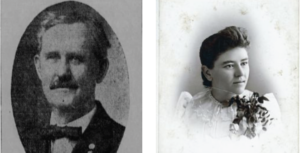
Frank and Lucy Huxtable, a married couple who both served.
Frank and Lucy Huxtable were a married couple from Wichita who both served in the war. According to “Lamps on the Prairie,” a 1942 history of nursing in Kansas, Lucy “was one of the first nurses to volunteer in 1898 — her number was sixty-seven or sixty-eight — for she had a husband in the Army” with the 21st Kansas Volunteers.
She hadn’t been summoned by early August, when the war was nearly over. But then she received a letter from her husband, who was in camp near Chattanooga, telling of horrible conditions there. According to the book, “She left at once for Chattanooga and immediately went to work in a small hospital that had been established by an English-trained nurse for officers and their families.” Not long after, she took charge of an infirmary that had been set up in the armory of an old Civil War prison, “where her only assistants were untrained people from churches and other organizations.” She later transferred to a military hospital near the coast to be near her brother. Conditions there were no better.
Frank, who’d served as a quarter master sergeant, died and was buried here in 1932, followed by Lucy a decade later.
A monument to the Spanish-American War stands in Central Riverside Park in the form of a 7-foot bronze statue called “The Hiker,” which depicts a soldier and which was dedicated in 1926. The second part of the monument — a Spanish cannon captured by American soldiers in Cuba during the war — was stolen and destroyed last year by a man looking for scrap metal to pay off a drug debt. It had been forged in Spain in 1794 and installed in the park in 1901.